
Almond
ValidatedCompared against the pressure chamber over multiple seasons and sites. Solid enough to drive commercial irrigation decisions.
Performance
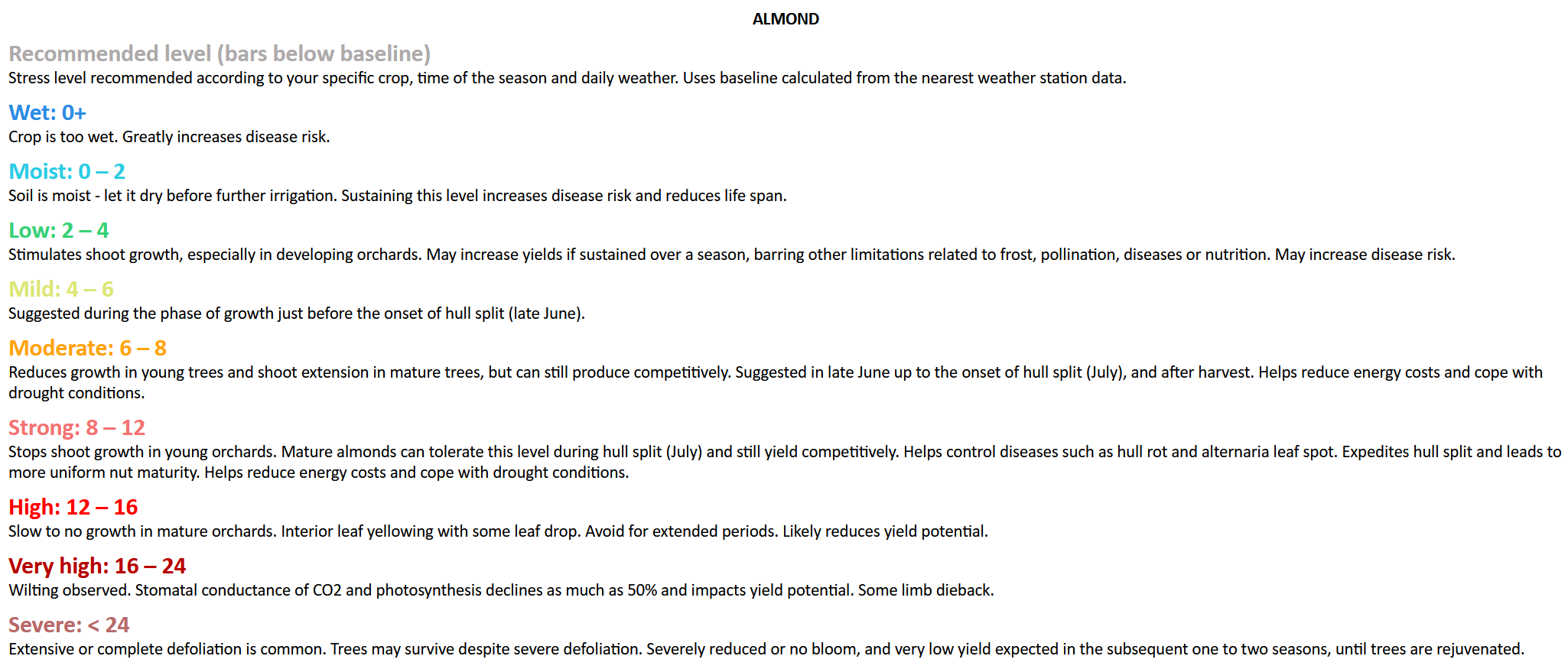
Excellent. Recommended for commercial use. Sensor data matches the pressure chamber, but can read 1-3 bars wetter during the spring. Thoroughly validated and used commercially.
Installation Tips
- Install after leaf out, on a 2+” branch. Installation into main trunk can be difficult if the bark is thick. Big and small sensors can work well.
- Sensors should be reinstalled after the winter, otherwise SWP will read too wet.
Known Issues
- Sensor install site can get blocked and sensor will read too wet, with little to no diurnal pattern. Reinstall.
- Sensors can get disconnected from xylem due to breaks in the mating compound. The sensors will then read very negative values during hot part of day. Reinstall.
Data & Validation
Almond sensor data showing good agreement with pressure chamber
Research Library
The FloraPulse almond advisory engine draws on 102 sources — 15 peer-reviewed papers plus university extension, industry and vendor guidance. All 102 citations are verified — against the Crossref or DataCite registry, the live document, or by hand against the publisher's record — and marked ✓. Each entry notes the specific finding it contributes. See these sources in the research library, which spans every crop.
Questions this research answers
- What did Goldhamer & Viveros 2000 find about almond irrigation?
- What did Stewart et al. 2011 find about almond irrigation?
- What did Goldhamer et al. 2006 find about almond irrigation?
- What did Goldhamer & Fereres 2017 find about almond irrigation?
- What did Drechsler et al. 2022 find about almond irrigation?
Peer-reviewed research (15)
- Drechsler, K., Fulton, A. & Kisekka, I. (2022). Crop coefficients and water use of young almond orchards. Irrigation Science, 40, 379-395. ✓
An observational study of three adjacent young Nonpareil/Monterey orchards in the northern Sacramento Valley measured mid-season crop coefficients of 0.35, 0.55, 0.88, 1.04 and 0.99 for 1- through 5-year-old orchards, concluding growers should use age-specific Kc until the 4th year, then switch to mature almond values.
- Goldhamer, D.A. & Fereres, E. (2017). Establishing an almond water production function for California using long-term yield response to variable irrigation. Irrigation Science, 35, 169-179. ✓
Five years of ten irrigation levels (1000 to 1350 mm) on mature Nonpareil found nut load unchanged across the whole range while individual kernel weight fell with deficit (15% lighter at the lowest level). Maximum yield, 3900 kg/ha, came at 1250 mm of applied water.
- Goldhamer, D.A. & Viveros, M. (2000). Effects of preharvest irrigation cutoff durations and postharvest water deprivation on almond tree performance. Irrigation Science, 19, 125-131. ✓
In a mature Nonpareil trial, withholding postharvest irrigation hurt the next season far more than preharvest cutoffs of 8 to 57 days: bloom density fell up to 52%, fruit set up to 94%, and kernel yield up to 74%. The authors advise growers with limited water to bias irrigation toward the postharvest period.
- Goldhamer, D.A., Viveros, M. & Salinas, M. (2006). Regulated deficit irrigation in almonds: effects of variations in applied water and stress timing on yield and yield components. Irrigation Science, 24, 101-114. ✓
Four seasons of RDI on mature Nonpareil in the southern San Joaquin Valley compared three stress-timing patterns at 55, 70 and 85% of seasonal ETc. Biasing the deficit to preharvest cut kernel weight most (17% at the lowest water level); biasing it postharvest cut fruit load; spreading it evenly through the season yielded best.
- Higbee, B.S. & Burks, C.S. (2021). Individual and Additive Effects of Insecticide and Mating Disruption in Integrated Management of Navel Orangeworm in Almonds. Insects, 12(2), 188. ✓
A ten-year commercial-scale almond trial in blocks of 96 to 224 hectares found mating disruption and insecticide to be additive: blocks receiving both had lower navel orangeworm damage than either alone in 9 of the 10 years, and adding insecticide mattered more than doubling dispenser density from 2.5 to 5 per hectare.
- Jha, P.K. & Pathak, T.B. (2024). Seasonal climate forecasts show skill in predicting winter chill. Comms. Earth Environ., 5, 485. ✓
Seasonal dynamic climate-model forecasts can predict California winter chill: anomaly correlations against reference chill exceeded 0.5 for most regions, and the forecasts assigned the right chill category over half the time across more than 40 percent of the Central Valley and southern California. Skill drops beyond a one-month lead.
- Maas, E.V. & Hoffman, G.J. (1977). Crop salt tolerance — current assessment. Journal of the Irrigation and Drainage Division, ASCE, 103(2), 115-134. ✓
The foundational salt-tolerance compilation. Its almond row (Prunus amygdalus) gives a soil saturation-extract threshold of 1.5 mmho/cm with a 19 percent yield decrease per additional mmho/cm beyond it, rated S for sensitive, and carries footnote c stating the almond tolerance is based on growth rather than yield.
- Orozco, J., Lauterman, F., Sperling, O., Paz-Kagan, T. & Zwieniecki, M.A. (2024). Losing ground: projections of climate-driven bloom shifts and their implications for the future of the almond industry in California. Scientific Reports, 14, 636. ✓
A modelling study of climate-driven almond bloom shifts in California. It projects little change in almond-suitable land over the next 30 years, but a 48 to 73 percent decline by 2100 under unchanged emissions, with bloom moving earlier from an average of day-of-year 64 over the past 40 years to day-of-year 28-33 by 2100.
- Pathak, T.B., Maskey, M.L. & Rijal, J.P. (2021). Impact of climate change on navel orangeworm, a major pest of tree nuts in California. Science of the Total Environment, 755, 142657. ✓
Ten general circulation models project navel orangeworm completing its generations markedly faster across California's Central Valley. In Sacramento County the first almond and walnut generation shifted from about day-of-year 193 historically to a range of 154 to 180, and fourth and fifth generations become routine rather than rare.
- Sperling, O. et al. (2025). Integration of seasonal rainfall and irrigation into a water management plan for almond orchards. Agric. Water Manage., 319, 109743. ✓
Across about 100 almond fields on seven California farms from 2020 to 2023, water availability drove canopy NDVI, winter carbohydrate storage and reproductive potential, and yield rose about 2.5 kg/ha per mm of irrigation over the 600 to 800 mm linear range. The authors conclude that delaying spring irrigation compromises reproductive potential.
- Stewart, W.L., Fulton, A.E., Krueger, W.H., Lampinen, B.D. & Shackel, K.A. (2011). Regulated deficit irrigation reduces water use of almonds without affecting yield. California Agriculture, 65(2), 90-95. ✓
A five-year northern Sacramento Valley trial held midday stem water potential at -14 to -18 bars through hull split and saved about 5 inches of water per year with no significant yield loss, though average kernel weight was slightly lower. The savings held even on soil with low water-holding capacity.
- Teviotdale, B.L., Goldhamer, D.A. & Viveros, M. (2001). Effects of deficit irrigation on hull rot disease of almond trees caused by Monilinia fructicola and Rhizopus stolonifer. Plant Disease, 85(4), 399-403. ✓
Almond trees irrigated at 70, 85 or 100% of ETc over two seasons: dead leaf clusters, spurs and twigs declined as applied water declined, and regulated deficits (50% of ETc for a short window around hull split) reduced hull rot more effectively than season-long sustained deficits. Kernel weight was greater at 85% than 70% of ETc.
- Tombesi, S. et al. (2010). Fruit development in almond is influenced by early spring temperatures in California. J. Hort. Sci. Biotech., 85(4), 317-322. ✓
Using bloom and hull-split dates for 12 California almond cultivars at three Central Valley sites over 8 years, the study found the full-bloom to hull-split interval was negatively correlated with degree-days accumulated over the first 90 days after full bloom (mean R2 0.51), a better fit than 30 or 50 days.
- Wilson, H. et al. (2020). Biology and Management of Navel Orangeworm (Lepidoptera: Pyralidae) in California. Journal of Integrated Pest Management, 11(1), 25. ✓
A review of navel orangeworm biology and management across California almonds, pistachios and walnuts. Because larvae contaminate kernels and adults can introduce aflatoxin-producing fungi, most operations target under 2% crop damage, achieved by combining orchard sanitation, well-timed sprays, timely harvest and mating disruption.
- Wilson, H., Daane, K.M., Maccaro, J.P., Scheibner, R.S., Britt, K.E. & Gaudin, A.C.M. (2022). Winter Cover Crops Reduce Spring Emergence and Egg Deposition of Overwintering Navel Orangeworm (Lepidoptera: Pyralidae) in Almonds. Environmental Entomology, 51(4), 790-797. ✓
In a replicated almond trial, remnant nuts placed in winter cover crop plots produced fewer navel orangeworm adults the following spring, indicating higher overwintering mortality, and also received fewer spring-laid eggs, likely because the ground cover interfered with moths locating and reaching them.
University & extension guidance (65)
- Allen, R.G., Pereira, L.S., Raes, D. & Smith, M. (1998). Crop evapotranspiration — Guidelines for computing crop water requirements. FAO Irrigation and Drainage Paper 56. ✓
The FAO reference for computing crop evapotranspiration as ETc = Kc x ETo. Its crop-coefficient table lists almonds with no ground cover at an initial Kc of 0.40, a mid-season Kc of 0.90 and an end-season Kc of 0.65, with a maximum crop height of 5 m.
- Ayers, R.S. & Westcot, D.W. (1985). Water quality for agriculture. FAO Irrigation & Drainage Paper 29 (Rev 1). ✓
The FAO water-quality toxicity chapter. Almond sits in the most sensitive class for foliar injury from sprinkler-applied water, damaged below 5 me/l of sodium or chloride, and has the lowest boron tolerance of the stone-fruit rootstocks listed. It also warns almond boron excess cannot be diagnosed by leaf analysis; look for gum on limbs or trunk.
- CDFA FREP. Almond Nitrogen Uptake and Partitioning. ✓
The companion page on almond nitrogen uptake and partitioning, built from sequential excavation of 13-year-old Nonpareil/Monterey trees yielding 4,800 lb kernels per acre. Its harvest-removal table gives a weighted average of 136 lb N removed per ton of kernels, counting hulls, shells and kernels, with a range of 102 to 174 across trials.
- CDFA FREP. California Fertilization Guidelines — Almonds. ✓
California's official almond fertilization guidelines: leaf and hull sampling, critical values, and rate and timing guidance for nitrogen, phosphorus, potassium, boron and zinc. July leaf nitrogen below 2% is deficient and can cut yield 20% or more, 2.2% is generally adequate, and N demand scales at 0.068 lb per lb of expected kernel yield.
- CDFA/APHIS. Navel Orangeworm Sterile Insect Technique Program (2025). ✓
CDFA's Navel Orangeworm Program page describes the joint CDFA / USDA-APHIS / tree-nut-industry area-wide effort that pairs sterile insect technique with sanitation, mating disruption, trap monitoring and sprays. Daily aerial sterile releases typically run March through October in selected San Joaquin Valley almond and pistachio orchards.
- FAO. Annex 1: Crop Salt Tolerance Data. ✓
FAO's crop salt tolerance annex. In Table A1.2 (woody crops) almond is rated S for sensitive, with tolerance based on shoot growth, a threshold of 1.5 dS/m soil saturation-extract ECe and a slope of 19 percent yield or growth loss per dS/m above that threshold.
- Fulton, A., Grant, J., Buchner, R. & Connell, J. (2014). Using the Pressure Chamber for Irrigation Management in Walnut, Almond and Prune. UC ANR Publication 8503. ✓
A UC ANR manual on using the pressure chamber to measure midday stem water potential and schedule irrigation in walnut, almond and prune. Its almond table calls -6 to -10 bars low stress, -10 to -14 mild, -14 to -18 moderate and tolerable during hull split, and -18 bars or drier something to avoid for long.
- Grattan, S.R. (UC Davis). Water Quality Guidelines for Trees and Vines. UC Drought Tip 92-19. ✓
UC Drought Tip 92-19 tabulates irrigation-water quality limits for trees and vines. Almond is rated salt-sensitive, at an irrigation water EC of 1.0 mmhos/cm for full potential falling to 2.8 for 50 percent (assuming a 0.15 leaching fraction); its rating is based on growth rather than yield. Boron above 0.5 to 0.75 mg/L can reduce growth and yield.
- Hanak, E. et al. (2023). Managing Water and Farmland Transitions in the San Joaquin Valley. PPIC. ✓
PPIC's September 2023 report projects that SGMA, climate change and new environmental flows will cut San Joaquin Valley farm water availability by about 3.15 million acre-feet a year by 2040, roughly 20 percent of supply, and that some 500,000 acres will need fallowing even in the best-case scenario.
- Lightle, D. (2019). Bee Hours and Almond Pollination. Sacramento Valley Orchards. ✓
Defines a good bee hour during almond bloom as an hour that is not raining, has wind under 10 mph and is warmer than 59 F, accumulated from bloom onset through petal fall. It then shows the metric explains little: regressing Butte County yield on bee hours from 1985 to 2011 gave an R2 of only 0.17.
- Sacramento Valley Orchards (adapted from Connell, J.H., 2011). Frost Protection for Almonds. ✓
UCCE frost-protection guidance for almond. Sprinklers protect by releasing latent heat as water freezes; in the reported trials sprinkled areas ran 1 to 2 F warmer than unsprinkled controls, and micro-sprinkler rates of 15, 25 and 40 gpm per acre barely moved air temperature but left exposed buds 1 to 2 F warmer at the higher rates.
- Sacramento Valley Orchards (UC Cooperative Extension). Advanced SWP Interpretation in Almond. ✓
UC Cooperative Extension's advanced almond SWP guide. It puts the ideal range at 2 to 8 bars below baseline, roughly -6 to -18 bars of midday stem water potential in absolute terms, pairs each band with expected symptoms, and publishes the fully irrigated baseline table by air temperature and relative humidity.
- Sacramento Valley Orchards (UC Cooperative Extension). Ant Management in Almonds. ✓
UCCE guidance on protein-feeding ants in almond, built around the UC IPM damage table: at 15 colony entrances per 5,000 sq ft in April-May, kernel damage runs 0.9 percent at 4 days on the ground and 4.9 percent at 21 days; at 185 entrances it runs 2.0 to 11.1 percent. Baits must go out weeks ahead of shaking and on dry soil.
- Sacramento Valley Orchards (UC Cooperative Extension). Hull Split Hull Rot Management — Alkaline Options. ✓
UC Cooperative Extension's Rhizopus hull rot program has three parts: bring the orchard to -14 to -18 bars stem water potential (pressure chamber) for two to three weeks starting just before any hull split then return to full ET, hold summer leaf nitrogen below 2.6 percent, and spray at early hull split.
- Sacramento Valley Orchards (UC Cooperative Extension). Maintaining Quality with Pick Up & Stockpiling. ✓
UC Cooperative Extension advice on almond pick-up and stockpiling: let hulls dry fully on the orchard floor and do not pick up or stockpile above 12 percent hull, 6 percent kernel or 9 percent total-fruit moisture. Orchard-floor drying is faster with north-south rows and where canopy light interception does not exceed 80 percent.
- Sacramento Valley Orchards. Almond Hull Rot — Cultural and Chemical Management. ✓
UCCE's hull rot management article advises irrigating when stem water potential reaches about four bars below baseline, usually -14 to -16 bars, holding that deficit two weeks at hull split before resuming full irrigation. It reports a properly timed deficit can cut hull rot strikes 80 to 90% without affecting yield or kernel size.
- Sacramento Valley Orchards. Almond Varieties (Cultivars). ✓
A UCCE variety-selection reference for Sacramento Valley almonds: pollen incompatibility groups, full-bloom timing relative to Nonpareil from the Chico regional trial (Sonora about 6 days earlier, Butte about 4 days later, Ruby about 10 days later), hull-split maturity, plum-rootstock compatibility, and the six kernel marketing categories.
- Sacramento Valley Orchards. Approaches to Spider Mite Management in Almonds. ✓
A UCCE comparison of two almond spider mite strategies: a prophylactic early abamectin spray versus threshold-based treatment that conserves natural enemies. It warns that once abamectin's roughly 60 days of activity fades and predators are gone, mites can reach damaging levels within a couple of weeks under summer heat and water stress.
- Sacramento Valley Orchards. Hull Split 2025 Considerations. ✓
UCCE's 2025 hull split guidance. Once blanks begin to split, shorten irrigation sets so trees reach -14 to -16 bars stem water potential before the next irrigation, then resume full irrigation between 90% split and the preharvest cutoff. It puts RDI's cost at roughly -2.5% kernel dry mass and +4% severe shrivel.
- Sacramento Valley Orchards. Hull Tights Caused by Water Stress. ✓
A UCCE field observation that severe water stress stalls hull split and causes hull tights: nuts sat at stage 2B for a week in trees whose FloraPulse sensors read -19 to -21 bars, up to 16.5 bars below baseline, and resumed splitting one day after irrigation. It advises holding trees 2 to 8 bars below baseline.
- Sacramento Valley Orchards. Potassium Management for Sustained Almond Yields. ✓
UCCE and UC Davis review of almond potassium: about 80 lb of K are exported per 1,000 kernel lb harvested, July leaf K above 1.4 percent is considered adequate, and trees given no potassium during a heavy crop year yielded 15 percent lower the following year through fewer surviving and flowering spurs.
- Sacramento Valley Orchards. Timing Almond Harvest in 2024. ✓
UCCE advisors' guide to almond harvest timing. Shaking can start once 100% of nuts reach hull split (stage 2C), and the article ties timing to irrigation: early shaking needs 7-14 days of orchard-floor drying versus 4-7 days at later stages, forcing an earlier water cutoff and risking sticktights on later varieties.
- SJV Trees & Vines. Fall and Winter Irrigation Management. ✓
UCCE guidance on post-harvest and winter irrigation for nut crops. Resuming irrigation after harvest is critical in almond because bud differentiation runs before and after harvest; from 30-year ETo at Five Points an almond block needs about 11.9 inches September through December, over half in September. Winter refill takes 3 to 6 inches.
- SJV Trees & Vines. Regulated Deficit Irrigation in Almonds to Manage Hull Rot. ✓
A UCCE advisor's practical guide to hull-split RDI for hull rot: cut irrigation 10 to 20% over the first two weeks of hullsplit and hold trees between -14 and -16 bars on a pressure chamber. It warns that overshooting causes sticktights and that full irrigation must resume, since postharvest stress cuts next year's fruit load.
- SJV Trees & Vines. Salt Leaching in Orchards and Vineyards. ✓
UCCE article on leaching salts from orchards. It puts the almond soil salinity threshold at 1.5 dS/m EC and says growth and yield fall 18-21 percent per unit above it on peach rootstocks such as Nemaguard or Lovell. Dormant winter leaching is more effective than in-season, which is done by lengthening each irrigation event 15-20 percent.
- Snyder, R.L. & de Melo-Abreu, J.P. (2005). Frost Protection: Fundamentals, Practice and Economics, Volume 1 — Chapter 4, Frost Damage: Physiology and Critical Temperatures. FAO. ✓
Chapter 4 of FAO's frost-protection manual. Its Table 4.6 gives percent damage expected for several almond varieties at pink bud, full bloom, petal fall and small-nut stages after 30 minutes below each listed temperature, and the text stresses these are only guidelines - chamber-derived values run colder than field values.
- Steduto, P., Hsiao, T.C., Fereres, E. & Raes, D. (2012). Crop Yield Response to Water. FAO Irrigation & Drainage Paper 66 (successor to FAO 33, Doorenbos & Kassam 1979). ✓
The FAO framework that ties yield loss to water deficit through a yield response factor Ky, where (1 - Ya/Yx) = Ky (1 - ETa/ETx). Ky above 1 marks a crop whose yield falls faster than its ET; below 1, one that partly recovers. The published Ky table covers field and vegetable crops and does not list almond.
- The Almond Doctor (D. Doll). Alkaline Treatments Have Been Shown to Reduce Hull Rot. ✓
The Almond Doctor summarizes UC Riverside trials in which one alkaline spray at 5 percent hull split - dipotassium phosphate at 48 oz/acre, calcium hydroxide at 320 oz/acre, or Cinetis at 24 fl oz/acre - cut Rhizopus hull rot strikes by over 75 percent versus untreated, matching several fungicide combinations.
- The Almond Doctor (D. Doll). Almond Frost Sensitivity. ✓
A grower-facing note on almond frost sensitivity: dormant buds tolerate freezing, but sensitivity rises from pink bud through full bloom to nutlets. It reports 50% or greater crop loss when bloom-stage tissue sits at 27 F for 30 minutes, with the threshold rising to 28 F after petal fall, and suggests 30 to 40 gpm per acre for sprinkler protection.
- The Almond Doctor (D. Doll). Bloom Time Diseases and Control. ✓
UCCE overview of the four almond bloom-time diseases -- brown rot, jacket or green fruit rot, shot hole and anthracnose -- with variety susceptibility rankings and spray guidance: no more than ten days between treatments in wet weather, anthracnose sprays every 7-10 days under rain, and no DMI fungicides for jacket rot (they miss Botrytis).
- The Almond Doctor (D. Doll). Brown Rot: A Disease Problem During Bloom. ✓
UCCE article on brown rot blossom blight (Monilinia laxa) in almond. Flowers are susceptible from pink bud to petal fall, most so fully open; the pink bud and full bloom sprays are standard with full bloom the most important. It reports a Butte orchard that missed its full bloom spray reaching over 50 percent blossom infection with no rain.
- The Almond Doctor (D. Doll). Chill Portions for California Crops. ✓
A table of chilling requirements in chill portions (Dynamic Model) for California tree crops. Almond is listed at 22 to 32 chill portions, with 'Nonpareil' at 23 - among the lowest requirements shown, well below pistachio at 54 to 65 and walnut at 38 to 72.
- The Almond Doctor (D. Doll). Cover Crop Research Review: How Can It Help Almonds? ✓
Two seasons of a UC four-site almond cover crop trial. Mature orchards gained yield after one year of cover cropping -- in Merced 225 lb/acre over resident vegetation and 217 lb/acre over bare soil, in Kern 94 lb/acre over bare soil. Cover crops added 82 to 126 lb N/acre versus bare orchards.
- The Almond Doctor (D. Doll). Fall Foliar Nutrients: Zinc and Boron Review. ✓
UCCE guidance on fall foliar zinc and boron in almond: summer leaf Zn of 15 ppm or less is deficient, hull B under 80 ppm is deficient (yield may still respond below 120 ppm) and B should not be applied at 200 ppm or more. Fall boron sprays at Nickels Soil Lab raised yield 200-400 kernel lb/acre the following year.
- The Almond Doctor (D. Doll). Hull Split Part 2: Hull Rot of Almond. ✓
An extension account of almond hull rot, where Monilinia or Rhizopus toxins kill spurs and shoots. It describes a UC trial holding fully irrigated trees at -7 to -9 bars midday stem water potential versus RDI at -14 to -18 bars: hull rot strikes per tree fell from 44.4 to 17.7 in 2002 and from 17.7 to 2.0 in 2003.
- The Almond Doctor (D. Doll). Independence Almond: Some Observations. ✓
Early UCCE field observations on the self-compatible Independence almond: a solid single-variety block gives one bloom, hull split and harvest timing, and trees look slightly smaller and more upright than Nonpareil with bloom overlapping it. The advisor still recommends at least one hive per acre and expects California-class marketing.
- The Almond Doctor (D. Doll). Irrigation Scheduling Part 1: Calculating Orchard Water Use. ✓
An extension walkthrough of scheduling almond irrigation from weather: almond water use ETc = ETo x Kc, with ETo from CIMIS. Its monthly almond crop coefficients peak at 1.15 in June through August with a cover crop and 0.90 without, and a worked example has a mature Merced County orchard using nearly 6.5 inches in May.
- The Almond Doctor (D. Doll). Late Fall K Soil Applications. ✓
UCCE guidance on late-fall soil potassium in almond: band rather than broadcast, because four years of broadcast moved K only 6 inches down while banded treatments penetrated 2 feet. It recommends an annual fall maintenance band of 500 lb potassium sulfate per acre 4-5 feet out from the trunk on both sides of the row.
- The Almond Doctor (D. Doll). Peach Twig Borer and May Spray Timing. ✓
The Almond Doctor advises hanging peach twig borer pheromone traps by the last week of March and making the May spray 400 to 500 degree-days after biofix (the first moths caught). It notes dormant and bloom timings as alternatives, and that mating disruption alone has not given reliable control.
- The Almond Doctor (D. Doll). Phytophthora: An Update. ✓
An update on almond Phytophthora arguing the pathogen should be assumed present in every orchard, since surface irrigation water carries it through filtration. Infection tracks excess water - saturated soil lets spores swim to the infection point and stresses the tree - so do not irrigate when soil moisture is already adequate.
- The Almond Doctor (D. Doll). Postharvest Water Management. ✓
An extension article on almond postharvest water demand, defined as mid-August through early November, when trees can use an estimated 12 to 15 inches, roughly 70% of it in the six weeks right after harvest. Shorting water then reduces next year's yield because floral bud differentiation runs mid-August into September.
- The Almond Doctor (D. Doll). Regulated Deficit Irrigation Application. ✓
An extension caution that hull-split RDI suits some orchards and not others. It targets -15 bars stem water potential for the two weeks before hullsplit and cites 5 to 15% seasonal water savings, but reports one orchard held at -15 to -20 bars midday SWP that lost 10 to 15% of kernel weight, about $500 per acre.
- The Almond Doctor (D. Doll). Shaking Almond Trees: When to Start. ✓
A grower-facing guide to shake timing: begin when 100% of nuts have split while hulls still hold moisture, since the added weight aids removal, and confirm with test shakes that take off 99% of nuts. Shaking early cuts navel orangeworm and hull rot but adds floor-drying time, ant exposure and bark-damage risk.
- The Almond Doctor (D. Doll). Shot Hole Fungus on Almond. ✓
UCCE description of shot hole (Wilsonomyces carpophilus) in almond. Infection needs moisture and temperatures above 36F/2C, and in warm conditions the fungus can sporulate and infect leaf tissue in under six hours, so leaf-wetness periods longer than six hours raise risk. The diagnostic is a small black fruiting body in the center of the lesion.
- The Almond Doctor (D. Doll). Soil Salinity and Leaching for Almonds. ✓
The Almond Doctor states almond yields are affected once average root-zone salinity exceeds 1.5 dS/m, with roughly a 19 percent loss in yield potential per additional 1.0 dS/m, and recommends starting a leaching program above that EC or above 5 percent exchangeable sodium, 5 meq/L chloride, or 0.5 mg/L boron.
- UC ANR Publication 8515 — Drought Management for California Almonds. ✓
A UC ANR drought tip on almond water stress by growth stage. It reports that a regulated deficit of 14 to 18 bars stem water potential from kernel fill through hull split did not reduce kernel yield over a four-year study, cost 2 to 3% of kernel weight, and saved 10 to 15% of the season's water budget.
- UC Davis Cost Study (2024). Sample Costs to Establish and Produce Almonds — Sacramento Valley. ✓
The 2024 UC Davis Sacramento Valley almond cost study, built on a micro-sprinkler orchard. Its mature-orchard budget applies 38 acre-inches of water from April to October, roughly twice a week over 25 weeks, on top of an assumed 6 acre-inches of soil-stored rainfall, priced at $200 per acre-foot, and assumes 2,200 kernel lb/acre at $1.60/lb.
- UC Davis Cost Study (2024). Sample Costs to Establish and Produce Almonds — SJV North. ✓
The 2024 UC Davis San Joaquin Valley North almond cost study, on a micro-sprinkler orchard. Its mature-orchard budget applies 42 acre-inches of water from March to October at an assumed 90 percent application efficiency, priced at $200 per acre-foot, and assumes 2,200 kernel lb/acre, which it describes as similar to the statewide average.
- UC Davis Fruit & Nut Research Center. About Chilling Hours, Units, and Portions. ✓
UC Davis reference page explaining how winter chill is counted in California: three chilling-hour and chilling-unit models (hours below 45 F, hours between 32 and 45 F, and the Utah model with its published hourly weightings) plus the Dynamic Model chill portions, whose accumulation this site starts each year on 1 September.
- UC IPM Phenology Model Database: Navel Orangeworm. ✓
UC IPM's phenology-model database entry for navel orangeworm, listing three published degree-day models that all use a 55 F lower and 93.9 F upper developmental threshold. Sanderson et al. (1989) put generation time (adult to adult) at 1092.6 degree-days F on mummy almonds versus 738.0 on new-crop almonds.
- UC IPM Phenology Model Database: Peach Twig Borer. Zalom et al. (1992), Rice et al. (1982). ✓
UC IPM's phenology database lists four peach twig borer degree-day models, all on a 50 F lower and 88 F upper threshold. The Zalom et al. 1992 almond model puts adult-to-adult generation time at 1,080 degree-days F from biofix (first male trapped) and the springtime spray at 400 degree-days F.
- UC IPM. Ants — Almond Pest Management Guidelines. ✓
UC IPM's ant guidelines: damage happens after nuts are shaken onto the ground and grows with time there. Its survey table shows southern fire ant damage rising from 2.0 percent at 4 days on the ground to 11.1 percent at 21 days where 185 colony entrances per 5,000 square feet were counted in April to May.
- UC IPM. Bacterial Canker — Almond Pest Management Guidelines. ✓
The UC IPM guideline for bacterial blast and canker in almond, caused by Pseudomonas syringae. It is favored by high moisture and low winter and spring temperatures, worse in low spots where cold air settles and in sandy ground with high ring nematode, and hits nitrogen-deficient and 2-to-8-year-old trees hardest. Copper does not suppress it.
- UC IPM. Brown Rot Blossom Blight — Almond Pest Management Guidelines. ✓
UC IPM: almond flowers can be infected by brown rot blossom blight from pink bud to petal fall and are most susceptible fully open, with infection favored by rainy weather in the mid-70s F. It advises treating at pink bud (5-10 percent bloom) and full bloom, one full-bloom spray usually sufficing in low-rainfall years.
- UC IPM. Ceratocystis Canker — Almond Pest Management Guidelines. ✓
UC IPM: Ceratocystis canker enters almond through wounds, most often mechanical shaker injury, and once infection occurs there is no cure - cankers expand each year and can girdle a 4-to-6-inch limb in three to four years. Mission, Ne Plus Ultra and Nonpareil are the most susceptible cultivars, so prevention means avoiding bark injury.
- UC IPM. Degree-Day Table for Navel Orangeworm. ✓
A UC IPM lookup table giving the day's navel orangeworm degree-days from that day's minimum and maximum temperature, computed with the single sine method, horizontal cutoff, and 55 F lower / 94 F upper thresholds. UC IPM flags the page as archived content that is no longer actively maintained.
- UC IPM. Hull Rot — Almond Pest Management Guidelines. ✓
UC IPM's almond hull rot guidelines. Hulls stay susceptible from the start of hullsplit until they dry, a window of 10 days to 2 months, and regulated deficit irrigation or reduced irrigation at hullsplit onset greatly reduces incidence. July leaf nitrogen should stay below 2.6%, and Nonpareil is among the most susceptible varieties.
- UC IPM. Navel Orangeworm — Almond Pest Management Guidelines. ✓
UC IPM's almond navel orangeworm guidelines. Winter mummy sanitation plus early harvest are named the essential controls; the single most effective spray timing is the start of hullsplit and no later than 1% hullsplit; and sanitation targets are regional - no more than 0.2 mummies per tree in the central and southern San Joaquin Valley.
- UC IPM. Peach Twig Borer — Almond Pest Management Guidelines. ✓
UC IPM's almond guidelines for peach twig borer: four generations a year, with larvae damaging both shoots and nutmeats. Preferred treatment is dormant, or at full bloom and petal fall; when a May spray is needed it goes on at 400 degree-days after biofix, accumulated on a 50 F lower and 88 F upper threshold.
- UC IPM. Peach Twig Borer in the Dormant Spur Sample — Almond Pest Management Guidelines. ✓
UC IPM notes that peach twig borer hibernacula found in a dormant spur sample should be recorded but do not on their own justify a spray: the treat-or-not decision rests on past orchard history and the previous year's fruit damage sample. If treating in dormancy, it steers growers to softer products such as spinosad.
- UC IPM. Phytophthora Root and Crown Rot — Almond Pest Management Guidelines. ✓
UC IPM's guidelines for Phytophthora root and crown rot in almond, where the control lever is water management. It states that periods of 24 hours or more of saturated soil favor infection, while good drainage and more frequent but shorter irrigations reduce risk, and water must never be allowed to stand around tree crowns.
- UC IPM. Shot Hole — Almond Pest Management Guidelines. ✓
The UC IPM guideline for shot hole in almond. Prolonged wetness from either rain or sprinkler irrigation is required for the disease to develop, so irrigation method matters. Treatment is keyed to monitoring: fruiting structures in fall leaf lesions mean a petal fall treatment is warranted, and their absence means it is not needed for shot hole.
- UC IPM. Webspinning Spider Mites — Almond Pest Management Guidelines. ✓
UC IPM's webspinning spider mite guidelines for almond. It names water stress as a direct cultural driver - preventing it, and reducing dust, is listed as cultural control - and directs pre-July monitoring at hot spots, which it says are often the dusty or water-stressed parts of the orchard.
- UCCE Kern County. Zinc in Almonds. ✓
A UCCE Kern County note on zinc in almond. It warns that poor nut set occurs before deficiency symptoms are visible, so sprays should be guided by leaf analysis - a leaf zinc level of 18 ppm or less calls for an application - and it lays out fall, dormant and spring spray options with rates.
- USDA Climate Hubs. Climate Vulnerabilities of California Specialty Crops. ✓
The USDA California Climate Hub page listing almonds as a top crop to watch in the Sacramento Valley, the Bay Area and Delta, and the San Joaquin Valley, on summer heat, chill-portion requirements, bee dependence and rising pest pressure. It names deficit irrigation as an adaptation and flags SJV warming as making water stress especially acute.
Industry & agency resources (15)
- Almond Board of California (2018, updated 2020). Moisture Management is Critical - Shaking to Stockpiles. ✓
An Almond Board industry article on moisture from shaking through stockpiling: do not stockpile if hull moisture exceeds 12 percent, kernel exceeds 6 percent, or total in-hull fruit exceeds 9 percent. If rain is forecast, hold off shaking, because wet nuts dry faster on the tree than on the orchard floor.
- Almond Board of California (2019, updated 2020). Successful Hullsplit Requires Thoughtful Irrigation, Nutrient Management. ✓
The Almond Board's hullsplit guidance on strategic deficit irrigation: stress trees from the start of hullsplit through 90% hullsplit, about two weeks, holding pressure-chamber readings between -14 and -18 bars depending on weather. It reports SDI can cut hull rot strikes 60 to 90% and give a more uniform split and earlier harvest.
- Almond Board of California (2021). Cover Crop Best Management Practices. ✓
An Almond Board of California guide, with NRCS and UC authors, laying out winter cover cropping in almond orchards as five stages -- planning, planting, growth, termination and post-termination -- with a month-by-month calendar, species choice by orchard age and goal, and guidance on what each irrigation system can support.
- Almond Board of California. Irrigation Calculator & Irrigation Improvement Continuum. ✓
The Almond Board's free online Irrigation Calculator, hosted on the California Almond Stewardship Platform. It links a grower's orchard and irrigation-system details to the nearest CIMIS station's evapotranspiration data to generate irrigation schedules and run times, and supports the practices in the Almond Irrigation Continuum.
- Almond Board of California. Managing Navel Orangeworm During First, Second Flight. ✓
Almond Board guidance on managing navel orangeworm through its first and second flights. It advises the first hullsplit spray no later than 1% hull split, predicts egg-laying from an April or May egg-trap biofix plus 1050 degree-days, and cites UCCE work showing mating disruption halved damage for an average net return of $123 per acre.
- Almond Board of California. Stockpile Management Best Practices — Grower Guide. ✓
The Almond Board's grower stockpiling guide sets pre-stockpile moisture limits of below 6 percent for the in-shell kernel, under 9 percent for the whole in-hull fruit and under 12 percent for hulls, and says to sample the worst-case nuts on the north side of the canopy next to the trunk, where moisture runs about 2 percent higher.
- Coatney, K. (2025). Act Now to Protect Almond Harvest from Ant Damage. West Coast Nut. ✓
A West Coast Nut interview with UC IPM advisor Sudan Gyawaly on almond ant damage, which he says is almost entirely a post-shake problem. Three of the four labeled baits must go out at least four to six weeks before harvest; the newer Altrevin acts within days and can be applied about two weeks out.
- Progressive Crop Consultant (2019). Iron Deficiency in Fruit and Nut Crops in California. ✓
A Progressive Crop Consultant review of iron deficiency in California fruit and nut crops: it is uncommon in the state and is caused less by low soil iron than by high pH, free lime and bicarbonate blocking uptake. It suggests acidifying irrigation water carrying over 2 meq/L bicarbonate and using tolerant rootstocks such as Hansen 536 or GF 677.
- Shackel, K.A. (UC Davis). Delayed irrigation-start trials, Tehama Co. almond (begun 2020) and Patterson walnut. Reported in West Coast Nut, Jan 2021. ✓
A West Coast Nut report on UC delayed-irrigation-start trials. Six years of walnut work found yield only about 10% below control when irrigation was delayed until stem water potential hit 4 bars below baseline. Two almond trials launched in 2020 showed no first-year yield difference between delayed and control plots.
- West Coast Nut (2019). Almond Post-Harvest Irrigation. ✓
An industry summary of why postharvest irrigation drives next year's crop. Recounting Goldhamer and Viveros (2000), it notes trees with even an 8-day preharvest cutoff lost 41% of next year's nuts per tree if given no postharvest water, while among trees that did get it, preharvest cutoff timing did not affect next year's yield.
- West Coast Nut (2020). Almond Flower, Foliar, and Fruit Diseases and Their Management. ✓
A West Coast Nut write-up of UC Riverside pathologist Jim Adaskaveg surveying almond bloom, foliar and fruit diseases. He puts the brown rot infection window at the 7-to-14-day bloom period of each variety, with germination within hours of wetness at 64 to 77 F, and advises one delayed-bloom spray under low pressure and two under high.
- West Coast Nut (2021). What Growers Have Learned About Growing Self-Fertile Almonds. ✓
Trade-press account of grower experience with self-fertile almonds. Independence is the leading one at 59,650 acres in the USDA 2020 acreage report; most growers still rent about a hive per acre as insurance, the smaller trees pushed growers to tighter spacing, and advisors warn it is commonly under-irrigated and under-fertilized.
- West Coast Nut (2022). Scouting for Ants — 'The Silent Yield Robbers'. ✓
Trade-press piece on scouting almond orchards for protein-feeding ants in April-May, citing the same UC IPM damage table. It explains ant damage is easy to miss because hollowed nuts blow out of the windrow and never reach the grade sheet, and notes southern fire ant nests concentrate at the edges of the wetted areas in drip-irrigated orchards.
- West Coast Nut (2024). Get Ahead of Irrigation Before a Heatwave Hits. ✓
An industry article arguing growers should irrigate ahead of a forecast heatwave rather than during it, so moisture is already in the root zone. It warns that low-volume drip has little catch-up capacity and that depleted soil-moisture reserves show up later, at almond harvest, when the crop still has to dry down.
- West Coast Nut (2025). Sterile Moths in Battle Against Destructive Pest. ✓
APHIS and CDFA report that in the 2024 season, across two 640-acre almond and two 640-acre pistachio orchards, sterile-moth releases cut almond damage by nearly 60 percent versus untreated controls and by up to 75 percent where SIT was paired with mating disruption. About 176.5 million sterile moths were released.
Vendor documentation (7)
- BeeHero (2024). The Impact of Adverse Weather in Almond Pollination (2023 bloom). ✓
Hive bee-counter data from four monitored colonies at a Central Valley pollination research station during a cold, stormy almond bloom. Foraging averaged nearly 60,000 trips per day in the warm spell of 17-21 February, collapsed to a few hundred on 24 February as temperatures fell, and recovered to about 60,000 by 2 March.
- Brandt. Pre-bloom Application of Zinc and Boron on Almonds. ✓
Vendor agronomy page arguing for foliar zinc and boron from pink bud to 10 percent bloom. It sets summer leaf Zn of 15 ppm or less as deficient and under 25 ppm as likely to respond, hull B under 80 ppm as deficient and under 120 ppm as likely to gain nut set, and warns hull B above 300 ppm can cause gumming and stick-tight nuts.
- Dave Wilson Nursery. Commercial almond variety information (bloom/harvest timing relative to Nonpareil; almond-wide chill ~350-500 hours). ✓
A commercial nursery's almond variety catalog. It gives a single species-level figure - an estimated chilling requirement of 350 to 500 hours - and notes that earlier bloom generally indicates a lower chilling requirement, then describes each variety by bloom and harvest date relative to Nonpareil, shell seal, kernel size and shelling percentage.
- Phytech. AlmondBeat #3 (2025): Managing Stress During Nut Fill. ✓
A vendor agronomy note on almond nut fill, mid-April through end of June, when stress directly costs kernel weight. It recommends pre-irrigating ahead of forecast heat, frequent or pulse irrigation instead of long weekly sets, avoiding heavy nitrogen after June to limit later hull rot, then beginning RDI as hull split nears.
- Rivulis. The Importance of VPD in Crop Performance. ✓
An irrigation-vendor explainer on vapor pressure deficit in almond. It gives an optimal range of roughly 1 to 3 kPa by day and 0 to 0.6 kPa at night, argues high nighttime VPD limits overnight tissue rehydration, and recommends late-afternoon or early-evening irrigation ahead of high-VPD periods. It concedes no accepted nighttime threshold exists.
- Semios. Comparing Degree Day Tracking Sources for Navel Orangeworm Generation Flight Prediction. ✓
A vendor case study comparing navel orangeworm degree-day accumulation from in-canopy sensors in 13 southern San Joaquin Valley almond orchards against regional weather stations and a modeled dataset. From an April 1 biofix, regional and modeled data ran on average 6.25 and 8.50 calendar days early for the first and second generations.
- Semios. How Post-Harvest Irrigation Affects Almond Yield. ✓
A vendor explainer built on Goldhamer and Viveros (2000): skipping postharvest irrigation cut the next year's kernel yield 43 to 54% across the 8-, 15- and 21-day preharvest cutoff treatments. It argues postharvest need is modest, enough to keep leaves alive until fall rains, and also serves winter salt leaching.