
Apple
ExperimentalThe sensor gives usable readings here, but the dataset is thin and there are no published thresholds. Sold for research and supervised field trials only — not for commercial irrigation scheduling. Growers: stick to the Validated list.
Performance
Recommended for experimental use only. Apple was validated with the older 9 mm probe installed deep; with the current 7 mm probe many installs flood out mid-season and read falsely wet. A deeper sleeve for the 7 mm probe is in development. Not recommended for commercial irrigation decisions until that is resolved.
Installation Tips
- Very easy install, apple xylem is usually uniform and healthy.
- Ensure the bubble wrap insulation is loose so that excess moisture can evaporate, particularly important in wetter climates.
- Sensors may freeze during the winter if temperatures go below 0 °C
- Keep the install site out of the sprinkler wetting zone, and shield it from stemflow running down the trunk.
Known Issues
- Installs commonly flood out mid-season: the signal goes flat near zero, loses its daily cycle, and reads falsely WET - the dangerous direction, since a grower can irrigate off it. Pulled probes bench-test fine; it is the install site that waterlogs and the tree seals off.
- Apple was validated on the 9 mm sensor, which is discontinued. The 7 mm replacement has not been re-validated in apple.
- Sensors can also read 0 when the trunk is wet. Attach insulation loosely to allow evaporation.
Data & Validation
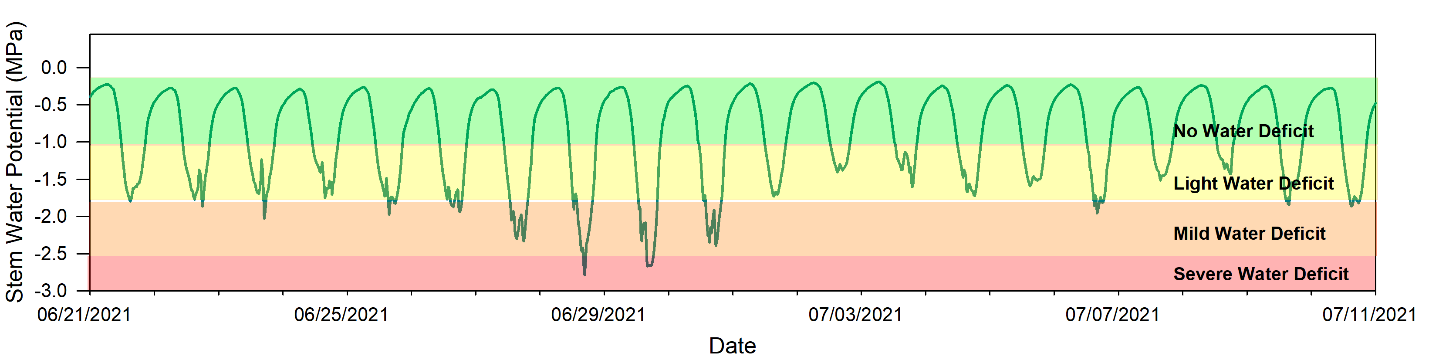
Apple sensor data validation
Research Library
The FloraPulse apple advisory engine draws on 74 sources — 14 peer-reviewed papers plus university extension, industry and vendor guidance. All 74 citations are verified — against the Crossref or DataCite registry, the live document, or by hand against the publisher's record — and marked ✓. Each entry notes the specific finding it contributes. See these sources in the research library, which spans every crop.
Questions this research answers
- What did Naor et al. 1995 find about apple irrigation?
- What did Naor et al. 1997 find about apple irrigation?
- What did Naor et al. 2008 find about apple irrigation?
- What did Mpelasoka et al. 2000 find about apple irrigation?
- What did Reid & Kalcsits 2020 find about apple irrigation?
Peer-reviewed research (14)
- Fallahi, E., Neilsen, D., Neilsen, G.H., Fallahi, B. & Shafii, B. (2010). Efficient irrigation for optimum fruit quality and yield in apples. HortScience, 45(11), 1616-1625. ✓
An Idaho trial scheduling 'Autumn Rose Fuji' apple by ETc with a Kc adjusted for ground shade and canopy maturity: mature trees received 994 mm under full microjet sprinkler versus 614 mm under full drip. Uniform deficit drip at 65 percent of full reduced fruit size, but the same volume alternated side to side gave larger fruit.
- Gonzalez Nieto, L., Huber, A., Gao, R., Casagrande Biasuz, E., Cheng, L., Stroock, A.D., Lakso, A.N. & Robinson, T.L. (2023). Trunk Water Potential Measured with Microtensiometers for Managing Water Stress in 'Gala' Apple Trees. Plants, 12(9), 1912. ✓
Microtensiometers logging trunk water potential continuously in 'Gala' apple at Geneva, NY separated fully irrigated, rainfed and rain-excluded trees all season; a logistic fit against fruit growth rate gave a critical trunk water potential near -9.7 bars, above which growth showed no water-stress penalty in that humid climate.
- Luedeling, E. & Brown, P.H. (2011). A global analysis of the comparability of winter chill models for fruit and nut trees. International Journal of Biometeorology, 55(3), 411-421. ✓
A global comparison of three winter chill models across 5,078 weather stations found they are not proportional to one another: the chilling-hours to chill-portions ratio ranged from 0 to 34 across sites. The authors conclude a chilling requirement measured in one location may not be valid elsewhere, and the Utah model fails in subtropical regions.
- Maas, E.V. & Hoffman, G.J. (1977). Crop salt tolerance — current assessment. Journal of the Irrigation and Drainage Division, ASCE, 103(2), 115-134. ✓
The reference crop salt-tolerance compilation, which describes yield loss as a threshold ECe plus a percent-per-unit slope beyond it. Its table gives apple (listed as Pyrus malus) only a qualitative rating of sensitive; no threshold or yield-decline slope is published for apple, unlike almond (1.5 dS/m, 19 percent) or apricot (1.6, 24).
- Mpelasoka, B.S., Behboudian, M.H., Dixon, J., Neal, S.M. & Caspari, H.W. (2000). Improvement of fruit quality and storage potential of Braeburn apple through deficit irrigation. Journal of Horticultural Science & Biotechnology, 75(5), 615-621. ✓
Deficit irrigation of 'Braeburn' apple, imposed either 63-118 days after full bloom or from 118 days to harvest, raised dry-matter concentration, firmness, soluble solids and sugars at harvest and after storage and cut storage weight loss, without significantly lowering mean fruit weight or raising disorder incidence.
- Namkung, K.-B. & Yun, S.C. (2023). Improvement of Fire Blight Blossom Infection Control Using Maryblyt in Korean Apple Orchards. The Plant Pathology Journal, 39(5), 504-512. ✓
Korean study running the Maryblyt model at 31 apple sites from 2021 to 2023. Maryblyt's four BHWT conditions are open bloom, epiphytic infection potential above 100, more than 2.5 mm precipitation, and a daily average temperature above 15.6 C; meeting all four is an infection-level blossom blight warning.
- Naor, A., Klein, I. & Doron, I. (1995). Stem water potential and apple size. Journal of the American Society for Horticultural Science, 120(4), 577-582. ✓
In a 'Golden Delicious' orchard drip-irrigated at 440 mm versus 210 mm during cell enlargement, midday stem water potential separated the two treatments while midday leaf water potential did not, and it tracked yield best (r-squared 0.71 for fruit over 65 mm at the first harvest and 0.74 for total yield).
- Naor, A., Klein, I., Doron, I., Gal, Y., Ben-David, Z. & Bravdo, B. (1997). The effect of irrigation and crop load on stem water potential and apple fruit size. Journal of Horticultural Science, 72(5), 765-771. ✓
Three seasons of irrigation-by-crop-load trials in 'Golden Delicious' apple: midday stem water potential rose with irrigation rate and fell as crop load increased, and yield and average fruit size declined once it dropped below -1.3 MPa, so the authors propose -1.2 MPa as a practical midday stem threshold for irrigation control.
- Naor, A., Naschitz, S., Peres, M. & Gal, Y. (2008). Responses of apple fruit size to tree water status and crop load. Tree Physiology, 28(8), 1255-1261. ✓
In two semi-arid 'Golden Delicious' orchards irrigated at 1, 3 or 7 mm per day, midday stem water potential spanned -0.9 to -2.8 MPa and fell as crop load rose; mean fruit mass and the share of fruit over 70 mm in diameter both increased with midday stem water potential, with similar responses at both sites.
- Parchomchuk, P. & Meheriuk, M. (1996). Orchard cooling with pulsed overtree irrigation to prevent solar injury and improve fruit quality of Jonagold apples. HortScience, 31(5), 802-804. ✓
Pulsed overtree sprinkling of 'Jonagold' apples in British Columbia (2 minutes on, 4 minutes off, triggered above 30-32 C on a simulated-fruit sensor) cut visible solar injury by 15.8 percent in 1991 and 9.4 percent in 1992 and lowered peak fruit surface temperature by 8.1 C on a day when uncooled fruit averaged 45.6 C.
- Reid, M. & Kalcsits, L. (2020). Water deficit timing affects physiological drought response, fruit size, and bitter pit development for 'Honeycrisp' apple. Plants, 9(7), 874. ✓
Withholding water from 'Honeycrisp' apple during mid- or late-season fruit expansion shifted the harvest toward smaller fruit and lowered bitter pit with no loss of fruit quality; across 2017-2019, fruit under 80 mm had 27 percent bitter pit after storage versus over 50 percent above 80 mm. Stress was tracked as midday stem water potential.
- Ribeiro, A.C. et al. (2006). Apple orchard frost protection with wind machine operation. Agricultural and Forest Meteorology, 141(2-4), 71-81. ✓
Field study over 11 spring frost nights in an apple orchard: each 1 C of temperature inversion strength between 1.5 and 15 m height produced about a 0.3 C air temperature rise at 1.5 m while the wind machine ran, and fan operation reduced flower damage by 60 percent in 1999 and 37 percent in 2000.
- Tan, B.Z., Close, D.C., Quin, P.R. & Swarts, N.D. (2021). Nitrogen Use Efficiency, Allocation, and Remobilization in Apple Trees: Uptake Is Optimized With Pre-harvest N Supply. Frontiers in Plant Science, 12, 657070. ✓
Two-season 15N tracer study on 14-year-old Gala/M26 apple trees comparing pre-harvest, post-harvest and split fertigation. Uptake efficiency of applied nitrogen was significantly higher for pre-harvest timing (32.0 percent) than for the others (about 17 percent), so the authors argue for shifting from post-harvest to pre-harvest N.
- Wan Zaliha, W.S. & Singh, Z. (2010). Impact of regulated deficit irrigation on fruit quality and postharvest storage performance of 'Cripps Pink' apple. Acta Horticulturae, 877, 155-162. ✓
Regulated deficit irrigation of 'Cripps Pink' apple from 135 days after full bloom to harvest: the most severe cut (20 L/h versus 70 L/h commercial) lowered leaf water potential, deepened anthocyanin skin color and raised soluble solids and firmness with slightly smaller fruit, which stayed firmer in cold and CA storage.
University & extension guidance (49)
- Allen, R.G., Pereira, L.S., Raes, D. & Smith, M. (1998). Crop evapotranspiration — Guidelines for computing crop water requirements. FAO Irrigation and Drainage Paper 56. ✓
FAO-56 defines crop evapotranspiration as ETc = Kc x ETo, and its Table 12 gives apple (grouped with cherries and pears, 4 m tall) a Kc mid of 0.95 and Kc end of 0.70-0.75 with no ground cover, rising to Kc mid 1.20 where an active ground cover is grown.
- Ayers, R.S. & Westcot, D.W. (1985). Water quality for agriculture. FAO Irrigation & Drainage Paper 29 (Rev 1). ✓
The linked chapter of this FAO water-quality guide covers chloride, sodium and boron toxicity rather than salinity yield thresholds, and none of its tables carry an apple row. Its one apple-specific point: pome fruits are easily damaged by boron yet do not accumulate enough in leaves for leaf analysis to diagnose it.
- Ballard, J.K., Proebsting, E.L. & Tukey, R.B. (1981, rev. 1998). Critical Temperatures for Blossom Buds — Apples. WSU Cooperative Extension Bulletin EB0913. ✓
WSU extension bulletin tabulating apple blossom-bud critical temperatures by development stage, giving the average temperature that kills 10 percent and 90 percent of buds: 15 F and 2 F at silver tip versus 28 F and 25 F at full bloom. Values are for Red Delicious; Rome Beauty is about 2 degrees hardier until petal fall.
- California OEHHA. Indicators of Climate Change in California — Winter Chill. ✓
California's climate-change indicator report tracks winter chill in the Central Valley and finds declining trends in both chill hours and chill portions, with statistically significant chill-hour declines at most stations analyzed. For crop context it cites apple as requiring 1,200 to 1,500 chill hours, or about 50 chill portions.
- Cornell Cooperative Extension ENYCHP (2025). Managing Honeycrisp Nutrition. ✓
Cornell's 2025 Honeycrisp nutrition guidance targets leaf nitrogen near 2.0 percent in early July, leaf potassium at 1.0-1.3 percent (below Gala) and leaf calcium at 1.5-2.0 percent to limit bitter pit, and it advises controlling or stopping irrigation about 6-7 weeks before harvest plus 8-10 calcium sprays at 10-day intervals.
- Cornell Jentsch Lab. Bloom: Preserving the King. ✓
Cornell Hudson Valley blog post on protecting the king bloom, mostly bloom-period insect guidance. Its horticultural point is that keeping king fruit and removing laterals gives best yield and size, and that losing king fruit to frost, fire blight or insects makes stress-based chemical thinners less effective and lateral thinning less predictable.
- Cornell Jentsch Lab. Effective Pollination — The Next Three to Five Days. ✓
Cornell post on the effective pollination period in apple. Pollination must occur within 2 to 4 days of a flower opening or the embryo sac degenerates; pollen may fail to germinate below 41 F and pollen tube growth is very slow below 51 F, so bees can be flying while fertilization still fails. Reported EPP is 3 to 12 days by cultivar.
- Cornell NEWA. Apple Scab Model. ✓
NEWA's apple scab tool page, which runs a station-weather model tracking ascospore maturity, daily and cumulative ascospore discharge, and scab infection events. Its management guide stresses that good control of primary infections lets summer fungicide use be reduced or omitted once ascospores are depleted.
- Cornell NYS IPM. Apple Maggot - Rhagoletis pomonella (fact sheet). ✓
Cornell fact sheet on apple maggot biology, damage and trapping. It reports that volatile-baited red sphere traps catch flies efficiently enough to replace the old one-fly rule, with a cover spray advised only once catches average 5 flies per trap across three traps hung in a 10 to 15 acre block.
- Montana State WARC. Apple Irrigation. ✓
Montana State's Western Agricultural Research Center orchard guide, which puts apple seasonal water use at roughly 20 inches (1.7 acre-feet) against a state average of 14 inches of precipitation falling mostly in dormancy, then walks growers through water rights, system choice and ET-based scheduling.
- MSU Extension. A perfect apple harvest season for watercore. ✓
MSU extension article on watercore in apple. Advanced fruit maturity is treated as a required condition, and the disorder is favored by warm sunny days paired with cold nights, which build photosynthate while fruit sink strength is too low to take it up. Red Delicious, Fuji, Honeycrisp, Jonagold, Granny Smith and Braeburn are listed as susceptible.
- MSU Extension. Comprehensive Honeycrisp Harvest and Storage Recommendations. ✓
MSU storage recipes for Honeycrisp, which is unusually chilling-sensitive. It advises harvesting before 60 percent starch clearing, preconditioning five to seven days at about 50 F, then storing at 36 to 38 F, and notes preconditioning can worsen bitter pit, so field-side crop load and calcium sprays still matter.
- MSU Extension. Critical Spring Temperatures for Tree Fruit Bud Development Stages. ✓
One-page MSU chart compiling critical spring temperatures by bud stage for pome and stone fruit, listing the old 30-minute standard temperature alongside 10 percent and 90 percent bud-kill values. Its apple column is drawn from WSU bulletin EB0913 and matches those figures.
- MSU Extension. Managing mites in apples. ✓
MSU extension article on mite management in Michigan apples, built around binomial sampling of 25 intermediate-aged leaves at three to five sites per block. Its treatment threshold for European red mite is 5 to 7 mites per leaf through July, rising to 10 to 15 per leaf in August.
- Penn State Extension. Apple PGRs — Prevention of Pre-harvest Drop. ✓
Penn State comparison of the three preharvest-drop materials for apple: Harvista (1-MCP), ReTain (AVG) and NAA. ReTain is applied about 3 to 4 weeks before harvest, while a single 10 to 20 ppm NAA spray holds drop for 7 to 10 days. It warns that trees stressed by drought, heat or mites respond poorly to ReTain.
- Penn State Extension. Frost, Critical Temperatures, and Frost Protection. ✓
Penn State's general orchard frost reference, covering radiation versus advective freezes, site and orchard-floor effects, and active protection methods. It states that over-tree sprinkling must start when air temperature falls to 33 F, applies 0.10 to 0.15 inch per hour, and at best protects only down to 24 F.
- Penn State Extension. Fruit Harvest — Determining Apple Fruit Maturity and Optimal Harvest Date. ✓
Penn State guide to judging apple maturity. It advises sampling weekly starting 4 to 5 weeks before expected harvest and combining several indices rather than one; fruit for long-term storage should be at least 15 lbs firmness and 13 to 15 lbs for short-term. It notes soluble solids fall with excessive rain or irrigation.
- Penn State Extension. Sooty Blotch and Flyspeck of Apples in the Home Fruit Planting. ✓
Penn State reference on sooty blotch and flyspeck, surface-blemish diseases that can infect any time after petal fall and appear mid to late summer. Outbreaks follow extended above-normal summer temperatures combined with frequent rain and high humidity, and pruning that opens the canopy so fruit dry faster after rain helps control them.
- Schmidt, T. (2018). Apple Sunburn 101. WSU Tree Fruit (archived). ✓
WSU's primer on apple sunburn: necrosis kills tissue near 126 F fruit surface temperature, while the costlier sunburn browning needs only about 114-120 F for roughly an hour and is cultivar-specific. Fruit surfaces can run up to 30 F above air temperature, so damage occurs on days only in the 90s.
- Smith, T.J. (WSU) & Drake, S. (USDA ARS). Late-Summer / Early-Fall Nitrogen Applications to Apple. WSU Chelan-Douglas Extension (archived). ✓
Four-season WSU trial in a marginally nitrogen-deficient Golden Delicious block compared an August 20 nitrogen application with the traditional November plus May timing. August timing gave larger, higher-N flower clusters and early-season leaves, more return bloom and higher light-crop-year yields, with no fruit quality penalty.
- Snyder, R.L. & de Melo-Abreu, J.P. (2005). Frost Protection: Fundamentals, Practice and Economics, Volume 1 — Chapter 4, Frost Damage: Physiology and Critical Temperatures. FAO. ✓
FAO frost-protection chapter on freeze-injury physiology and published critical temperatures. Its apple table (4.7, after Proebsting and Mills) lists 10 percent and 90 percent kill temperatures by stage, from -11.9 C and -17.6 C at silver tip to -2.9 C and -4.7 C at full bloom, and cautions such values are guidelines, not absolutes.
- UC Davis Cost Studies (2023). Sample Costs to Produce Apples for Processing — Central Coast. ✓
A 2023 UC Cooperative Extension cost-and-return study for processing apples on California's Central Coast. It prices irrigation water at $282 per acre-foot ($23.50 per acre-inch) and budgets two summer irrigations of 3 acre-inches each in July and August to support fruit growth and sizing.
- UC Davis Fruit & Nut Research Center. About Chilling Hours, Units, and Portions. ✓
UC Davis explainer on how winter chill is counted. It describes the three common chilling-hour and Utah-model conventions, gives the Utah weighting table (including negative credit for hours above 60 F), and covers the Dynamic Model's chill portions. It gives no apple-specific chill number, pointing growers to nurseries and farm advisors instead.
- UC Davis Land Air Water Resources. Managing Irrigation in Fruit and Nut Trees During Drought. ✓
UC Drought Tip 92-09 states that bearing apple and pear trees tolerate water stress until the fruit is one-third to one-half grown and then need full irrigation for near-normal size; it cites Washington work where a 15 percent early-season growth loss was made up once full irrigation resumed. Preharvest deficits raise sunburn.
- UC IPM. Apple Scab — Apple Pest Management Guidelines. ✓
UC IPM guideline for apple scab, centered on preventing spring primary ascospore infections because controlling them makes summer control far easier. It reproduces the Mills and La Plante wetting table, where infection needs about 9 hours of continuous wetness at 61 to 75 F but 25 hours at 43 F.
- UC IPM. Codling Moth — Apple Pest Management Guidelines. ✓
UC IPM guideline for codling moth timing: biofix is set from pheromone trap catches once sunset temperatures reach 62 F, degree-days accumulate on a 50 to 88 F range, and the first-generation spray goes on at 250 degree-days. Overhead sprinkler irrigation or more than 0.5 inch of rain within two weeks of a spray forces a re-treatment.
- UC IPM. European Red Mite — Apple Pest Management Guidelines. ✓
UC IPM guideline for European red mite in apple. Its cultural control is to reduce orchard dust and keep trees well irrigated; treat if more than 10 percent of winter-sampled fruit spurs carry overwintering eggs, and summer thresholds run from 10 to 30 mites per leaf depending on tree age, variety, condition and predator numbers.
- UC IPM. Fire Blight — Apple Pest Management Guidelines. ✓
UC IPM guideline for fire blight names over-irrigation, excess nitrogen fertilizer and heavy pruning among the factors that worsen the disease, and warns that overhead sprinklers can aggravate it in susceptible cultivars. It advises starting the season with a full soil water profile so irrigation during bloom can be avoided.
- UC IPM. Phytophthora Root and Crown Rot — Apple Pest Management Guidelines. ✓
UC IPM guideline for Phytophthora root and crown rot, which calls proper water management the key to control. It states that periods of 24 hours or more of saturated soil favor infection, and that good drainage plus more frequent but shorter irrigations, such as pulse irrigation, reduce the risk.
- UC IPM. Woolly Apple Aphid — Apple Pest Management Guidelines. ✓
UC IPM guideline for woolly apple aphid, a bark- and root-feeding aphid whose main injury is tree stunting from root galls. It says the delayed-dormant application should control it, a summer treatment is needed only if the parasite Aphelinus mali has been disrupted, and Malling 106 and 111 rootstocks are resistant.
- UMass Amherst Apple IPM. Mites: European Red Mite & Two-Spotted Spider Mite. ✓
UMass fact sheet on European red mite and twospotted spider mite in apple, with thresholds that rise through the season: 1 to 2 motile mites per leaf (or 30 percent of leaves infested) from petal fall through June, 5 per leaf in July, and 7.5 per leaf August 1 to 15. It notes mites build up in hot, dry weather and in dusty hot spots.
- UMass Extension. F-119R: Foliar Calcium Sprays for Apples. ✓
UMass Extension's apple calcium program: start foliar sprays three weeks after petal fall and repeat at two-week intervals, aiming for eight sprays before harvest, using 2.0-2.7 lb technical-grade calcium chloride per 100 gallons dilute until mid-July and 2.7-3.3 lb after. Large fruit hold less calcium than small fruit.
- UMass Extension. Thinning Apples Chemically (HRT fact sheet). ✓
UMass Extension fact sheet on chemical thinning of apple. It targets 4 to 6 fruit per cm of limb circumference for fruit size and 8 to 10 within four weeks of bloom for return bloom, covers carbaryl, NAA, NAD and 6-BA rates and timing, and notes thinners penetrate better and work harder after cool moist weather than after warm dry spells.
- University of Maryland Extension. Managing Apple Growing Conditions to Prevent Fruit Cracking. ✓
University of Maryland review of apple fruit cracking. It attributes most cracking to abrupt changes in fruit water status, especially rain after a prolonged dry spell, and its main advice is maintaining a constant water supply through hot dry stretches. Gala, Fuji, Golden Delicious and Pink Lady are listed as susceptible.
- USDA-ARS. Overtree Evaporative Cooling System Design. ✓
USDA-ARS design guidance for overtree evaporative cooling of Pacific Northwest apples: it recommends over 40 gpm/acre cycled on fruit temperature (60-70 gpm/acre on a time clock with at least one 20-minute cycle per hour) and warns cooling adds 12-18 inches of water on top of the 39-48 inches a mature orchard already uses.
- Virginia Tech Tree Fruit Horticulture Updates (2023). Sprinklers for Frost Protection — What You Need to Know Before Turning Them On. ✓
Virginia Tech extension post on using orchard sprinklers for frost protection, framed around three checks before turning them on: wind, dew point, and whether the system can actually deliver enough water. It advises against sprinkling when wind exceeds 10 mph and says the method generally suits protection in the 24 to 32 F range.
- Wisconsin Fruit Extension (2022). Apple Tree Nutrition: Bitter Pit Control. ✓
Wisconsin Extension treats bitter pit as a calcium distribution and nutrient balance problem rather than a soil calcium shortage, and names weather as the largest driver: drought around bloom and again after petal fall in July cuts calcium uptake and raises bitter pit, while peel sap K/Ca above 25 in early July flags high risk.
- WSU Crop Protection Guide. Apple Sunburn - Fruit Surface Temperature Thresholds. ✓
WSU's Crop Protection Guide page on apple sunburn: necrosis follows fruit surface temperature above 125 F for as little as 10 minutes, browning follows 115-120 F combined with UV-B, and fruit can sit 20-30 F above air temperature. Mitigations listed are evaporative cooling, netting and sprayable protectants.
- WSU Crop Protection Guide. Bioregulator Sprays - Apogee/Kudos (Prohexadione-Calcium) for Apple. ✓
WSU guidance on prohexadione-calcium (Apogee, Kudos 27.5 WDG) for apple, a gibberellin-biosynthesis inhibitor that reduces shoot growth and tree vigor. One application holds growth only 4 to 6 weeks, so at least two per season are advised, starting when new terminal shoots are under 1 inch. It must not be mixed with calcium products or hard water.
- WSU Tree Fruit. Apple Pollination. ✓
WSU page on apple pollination. It states all apple varieties need some cross-pollination for fruit set, even those listed as self-fruitful, recommends crabapple pollinizers for their longer bloom, and names varieties that cannot serve as pollen donors, including Jonagold, Mutsu, Gravenstein, King, Baldwin and Winesap.
- WSU Tree Fruit. Apple Powdery Mildew. ✓
WSU reference on apple powdery mildew (Podosphaera leucotricha), which overwinters as mycelium in dormant buds. Unlike scab it needs no free water: germination occurs from 40 to 100 percent humidity and is completely inhibited by free water, temperatures are optimal between 55 and 80 F, and sprays run from tight cluster every 10 to 14 days.
- WSU Tree Fruit. Boron. ✓
WSU reference on boron nutrition in deciduous tree fruit. For apple it lists deficiency symptoms (drought spot, internal cork, cracking and russet, misshapen fruit, bark measles) and toxicity symptoms (more watercore and internal breakdown after harvest, premature ripening, shoot dieback), plus soil and whole-fruit boron diagnostic ranges.
- WSU Tree Fruit. Cougar Blight Fire Blight Risk Model. ✓
WSU summary of the Cougar Blight model: hourly temperature risk values for Erwinia amylovora accumulate over a 4-day window between 50 F and 95 F thresholds, and the risk cutoffs shift with the orchard's fire blight history. It notes that when bacterial populations are high, even mist from irrigation sprinklers can wet blossoms enough to infect.
- WSU Tree Fruit. Cross-compatibility of Apple Cultivars and Pollinizers. ✓
WSU reference on apple self-incompatibility, controlled by the multi-allelic S locus. It explains full incompatibility, semi-compatibility and full compatibility, notes triploid cultivars are unsuitable as pollinizers because of low pollen viability, and tabulates S-genotypes for major Washington cultivars and crabapple pollinizers.
- WSU Tree Fruit. Determining your irrigation schedule. ✓
WSU's how-to for building an orchard irrigation schedule: take weekly tree water use from ET (its table runs from about 0.05 in/day in early April to 0.27-0.38 in/day in July), correct for system efficiency, then divide by the usable water the soil holds over an assumed 2-3 ft root depth, refilling at 50 percent depletion.
- WSU Tree Fruit. Fall Nutrient Sprays in Tree Fruit. ✓
WSU guidance on fall foliar nutrient sprays, which go on after harvest between October and November but before leaves yellow. It cites work showing remobilized nitrogen supplies about 50 percent of next season's shoot N, 90 percent of spur leaf N and 60 percent of fruit N, and warns sprays are ineffective when tissue N is adequate.
- WSU Tree Fruit. Harvest Apples. ✓
WSU overview of apple maturity testing and harvest. It walks through starch-iodine, firmness, soluble solids, acidity, color and ethylene tests, and gives storage-candidate targets of the right background color, 25 to 35 percent starch conversion and firmness above 15 pounds, inside roughly a 7 to 11 day window before the ethylene climacteric.
- WSU Tree Fruit. Leaf Tissue Analysis. ✓
WSU guide to leaf tissue analysis as the most validated indicator of tree fruit nutrient status, sampled from recently mature leaves in July and August. Its apple standards include 1.7 to 2.5 percent nitrogen and 1.2 to 1.9 percent potassium, and it stresses tissue tests show what was taken up, not why or how much to apply.
- WSU Tree Fruit. Zinc. ✓
WSU guidance on zinc in tree fruit orchards. Deficiency shows as little leaf and rosette; soil applications are largely ineffective, so foliar sprays timed at silver tip on apple and pear or postharvest are preferred. WSU recommends an annual maintenance spray of 2 to 4 lb actual Zn per acre even with no visible symptoms.
Industry & agency resources (9)
- APAL (Apple and Pear Australia Limited). Post-Harvest Nutrient Management. ✓
Australian apple industry guidance on the narrow postharvest-to-leaf-fall window, when nutrients move from leaves back into buds and wood. It names nitrogen, boron, zinc and magnesium as the key foliar targets, applied as soon as each variety is picked while leaves still function; an example rate is 2 to 3 percent urea, 10 to 14 days apart.
- Cheng, L. (2013). Optimizing Nitrogen and Potassium Management to Foster Apple Tree Growth and Cropping Without Getting Burned. NYSHS / NY Fruit Quarterly. ✓
Cornell extension article on balancing nitrogen and potassium in apple orchards: excess N drives vegetative growth, poor color, storage problems and fire blight risk, while adequate K works the other way. It targets a leaf N:K ratio near 1.25:1 for McIntosh and 1.5:1 for most other varieties.
- Cheng, L. & Miranda Sazo, M. (2018). Why Is 'Honeycrisp' So Susceptible to Bitter Pit? NY Fruit Quarterly Spring 2018, 19-23. ✓
Comparing 'Honeycrisp' with 'Gala' in a New York orchard, Cornell found Honeycrisp peel held about half the calcium and nearly 50 percent more potassium, and that this calcium-to-potassium imbalance rather than bulk calcium tracks bitter pit; growers are estimated to lose 15-25 percent of the Honeycrisp crop on average.
- Good Fruit Grower. Calcium sprays for bitter pit should start at petal fall. ✓
Reporting Cornell pomologist Steve Hoying, this piece says eastern apple growers should begin calcium sprays soon after petal fall because most fruit calcium is taken up by mid-July and is diluted afterward; he suggests three to four cover sprays of 1-2 lb calcium chloride per 100 gallons at 14-day intervals.
- Good Fruit Grower. Stress for Success with Honeycrisp. ✓
A 2020 Good Fruit Grower article reporting that summer water deficits skew 'Honeycrisp' fruit size a little smaller, which in turn reduces bitter pit incidence. Only the article's summary deck is publicly readable; the body sits behind the magazine's paywall.
- Kalcsits, L. et al. (WTFRC). Sunburn and fruit acclimation in apple — Final Project Report. ✓
A WSU final report on apple sunburn acclimation: starting evaporative cooling once air temperature passed 85 F gave significantly less sunburn than waiting for 90 F, 'Honeycrisp' ran up to 10 F hotter at the fruit surface than Cripps Pink, Granny Smith or WA 38, and June exposure to near-threshold heat cut later sunburn.
- Lakso, A.N. & Goffinet, M.C. (2013). Apple Fruit Growth. New York Fruit Quarterly, 21(1), 11-14. ✓
Apple fruit grow by cell division for the first 4-5 weeks after bloom and then almost entirely by cell expansion, adding a similar weight each day until harvest; in thinning trials about 85 percent of the harvest size variation traced to cell number, so early crowding and thinning timing largely set final fruit size.
- Robinson, T. & Lakso, A. (2011). Advances in Predicting Chemical Thinner Response of Apple Using a Carbon Balance Model. New York Fruit Quarterly, 19(1), 15-20. ✓
Cornell work using the MaluSim carbon balance model to forecast apple chemical-thinning response from weather. Predicted multi-day carbohydrate deficits during the thinning window produced intense or excessive thinning while surpluses produced poor thinning, and the team advised growers to cut thinner rates or wait out a deficit.
- Robinson, T., Hoying, S., Iungerman, K. & Kviklys, D. (2010). ReTain Combined with NAA Controls Pre-Harvest Drop of McIntosh Apples Better Than Either Chemical Alone. New York Fruit Quarterly, 18(3). ✓
New York trials on McIntosh found ReTain alone controls preharvest drop poorly in hot Augusts (daytime highs over 95 F), when stressed trees produce ethylene and form an abscission layer early. Adding 20 ppm NAA to the ReTain spray two weeks before normal harvest improved drop control over ReTain alone.
Vendor documentation (2)
- Dave Wilson Nursery. Apple variety chill hours and harvest dates. ✓
Home-garden and retail nursery catalog listing more than 60 apple varieties with estimated chill-hour requirements, harvest timing and pollinizer needs. Estimates span roughly 100 hours for low-chill types such as Anna and Dorsett Golden up to about 1,000 hours; several entries note the variety fruited well on far less chill than the estimate.
- Rivulis. The Importance of VPD in Crop Performance. ✓
A vendor explainer on vapor pressure deficit: high VPD pulls water out of the canopy faster than roots can replace it, and it suggests late-afternoon or early-evening irrigation ahead of high-VPD periods. The entire page is written for almond, giving a daytime optimum of about 1-3 kPa, and never mentions apple.
Additional notes & resources
- Guidelines: Not yet established. Recommend irrigation by SWP trend.
- Sample guidelines for apple from Washington State University
- Microtensiometers: a new tool to monitor your apple trees for deciding when and how much to irrigate