
Blueberry
ExperimentalThe sensor gives usable readings here, but the dataset is thin and there are no published thresholds. Sold for research and supervised field trials only — not for commercial irrigation scheduling. Growers: stick to the Validated list.
Performance
Recommended for experimental use. Four seasons of USDA-ARS research in Oregon northern highbush blueberry (2022-2025) read consistently and matched the pressure-chamber trend, and the 2025 season (twelve stations across fully irrigated and deficit plots) gave a well-watered stem water potential baseline that agrees with the one published line. Not validated for growers: no commercial season yet, and the sensor needs a mature cane of about 17 mm or more.
Installation Tips
- Recommend using the 7mm sensor if the cane is at least 17 mm (0.65 in) in diameter, otherwise use the 3mm sensor. Install on a mature cane (plantings of year 4-5 or older).
- Blueberry is near-isohydric with a narrow working range (about -3 to -8 bar well-watered, xylem embolism from about -12 bar), so the dashboard profile runs tight stage triggers of 2-4 bar below its baseline.
Data & Validation
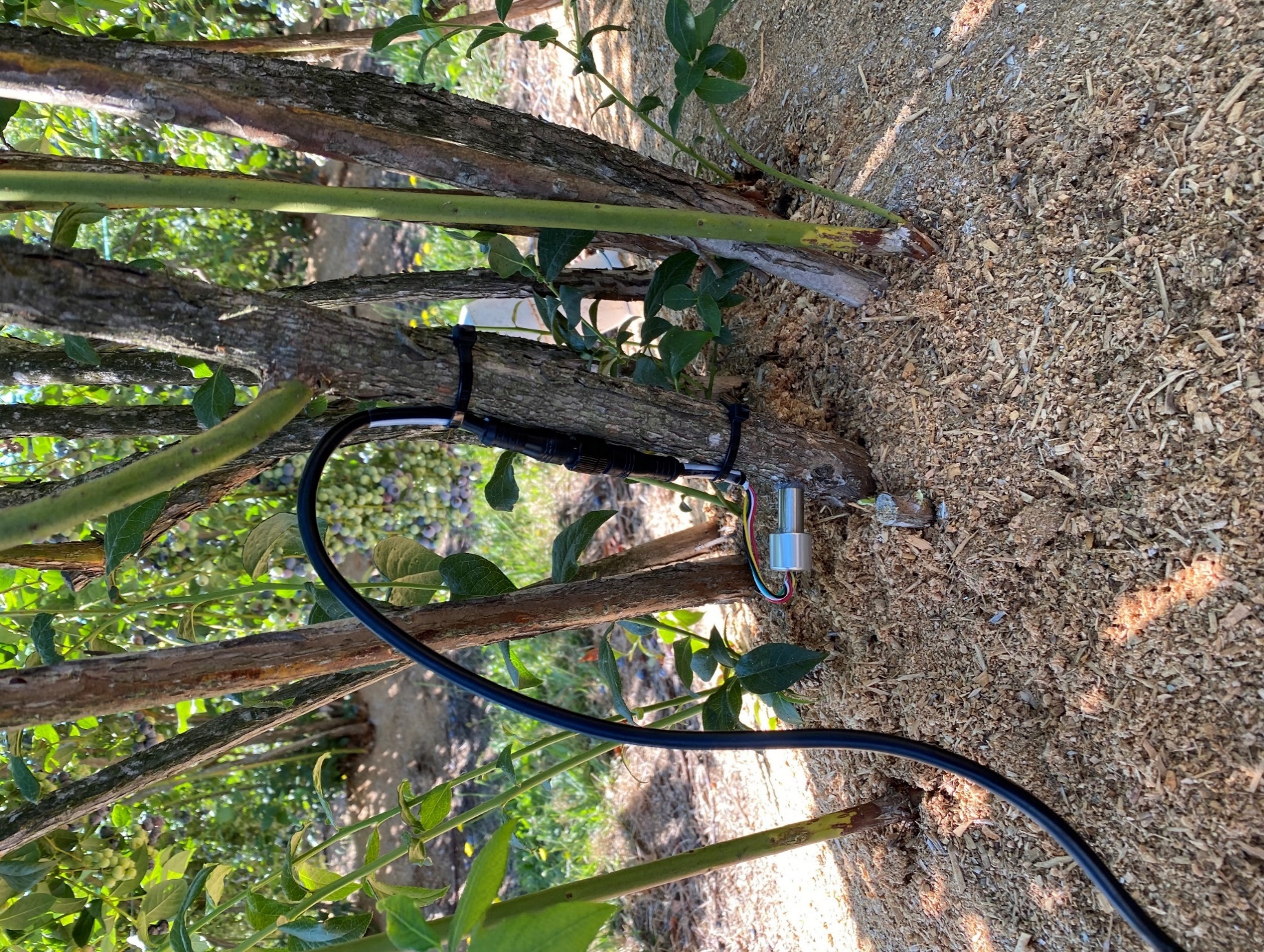
FloraPulse probe installed on a highbush blueberry cane
Research Library
The FloraPulse blueberry advisory engine draws on 51 sources — 23 peer-reviewed papers plus university extension, industry and vendor guidance. 50 of the 51 citations are verified — against the Crossref or DataCite registry, the live document, or by hand against the publisher's record — and marked ✓. Each entry notes the specific finding it contributes. See these sources in the research library, which spans every crop.
Questions this research answers
- What did Calderón-Orellana et al. 2023 find about blueberry irrigation?
- What did Lobos et al. 2018 find about blueberry irrigation?
- What did Lobos et al. 2016 find about blueberry irrigation?
- What did Khalid F. Almutairi & Bernadine C. Strik 2017 find about blueberry irrigation?
- What did Almutairi et al. 2021 find about blueberry irrigation?
Peer-reviewed research (23)
- Almutairi, K.F., Bryla, D.R. & Strik, B.C. (2021). Sensitivity of Northern Highbush Blueberry Cultivars to Soil Water Deficits during Various Stages of Fruit Development. HortScience, 56(2), 154-162. ✓
Two-week deficits at early green, late green or colouring, repeated two years, took Earliblue and Duke to -1.3, Bluecrop to -1.4 and Elliott and Aurora to -1.6 to -1.7 MPa; berry weight fell 6-15 percent in the second year, yield fell only in Aurora withheld at colouring, and Elliott set fewer buds after a Stage I deficit.
- Améglio, T., Le Roux, X., Mingeau, M. & Perrier, C. (2000). Water Relations of Highbush Blueberry under Drought Conditions. Acta Horticulturae, 537, 273-278. ✓
Bluecrop, as reported by Bryla and Strik 2007: xylem embolism negligible at -1.2 MPa or wetter, 50 percent loss of conductance at -1.4 MPa and complete loss at -2.1 MPa in excised segments; rapid stomatal closure keeps the plant above its cavitation threshold, and recovery took 7-9 days after rewatering.
- Bryla, D.R. (2011). Crop Evapotranspiration and Irrigation Scheduling in Blueberry. In: Gerosa, G. (ed.), Evapotranspiration - From Measurements to Agricultural and Environmental Applications, InTech, 167-186. ✓
Blueberry irrigation review: northwest Oregon early cultivars use about 3, 5, 7, 5 and 4 mm a day from May to September (drip requirement 2-4), irrigation before fruit set is minimal and often unnecessary, roots peak twice at soil 14-18 C, the larger flush after harvest, and flooding cut stomatal conductance within 5 days.
- Bryla, D.R. & Linderman, R.G. (2007). Implications of Irrigation Method and Amount of Water Application on Phytophthora and Pythium Infection and Severity of Root Rot in Highbush Blueberry. HortScience, 42(6), 1463-1467. ✓
Duke on raised beds at Corvallis: by year two drip-irrigated plants had half the shoot and root mass of sprinkler and microspray plants, Phytophthora infection was 14 percent on drip against 7 percent on the other systems, and infection rose with the amount of water applied under every system.
- Bryla, D.R. & Strik, B.C. (2006). Variation in Plant and Soil Water Relations among Irrigated Blueberry Cultivars Planted at Two Distinct In-Row Spacings. Acta Horticulturae, 715, 295-300. ✓
In irrigated Oregon highbush, stomatal conductance decreased rapidly as stem water potential approached -0.6 to -0.8 MPa, regardless of cultivar or in-row spacing: the onset of stomatal limitation.
- Bryla, D.R. & Strik, B.C. (2007). Effects of Cultivar and Plant Spacing on the Seasonal Water Requirements of Highbush Blueberry. Journal of the American Society for Horticultural Science, 132(2), 270-277. ✓
Oregon Duke, Bluecrop and Elliott: bagged-leaf midday potential in Elliott ran -0.4 to -0.5 MPa in late spring and -1.4 to -1.6 MPa by harvest under weekly sprinklers; Duke used 5-10 mm a day from mid-May to mid-August and Elliott 3-5, use peaked in fruit fill and ripening and declined markedly after harvest; almost all roots lay above 0.4 m.
- Bryla, D.R. & Strik, B.C. (2015). Nutrient Requirements, Leaf Tissue Standards, and New Options for Fertigation of Northern Highbush Blueberry. HortTechnology, 25(4), 464-470. ✓
Northern highbush fertigation: inject nitrogen weekly from leaf emergence to late July or early August, never all season; 100-150 lb N per acre for mature fields; ammonium sulfate, or urea where soil pH is below 5; drip lines 6-12 inches from the plant; polyphosphate plugs emitters in water high in calcium or bicarbonate.
- Bryla, D.R., Gartung, J.L. & Strik, B.C. (2011). Evaluation of Irrigation Methods for Highbush Blueberry - I. Growth and Water Requirements of Young Plants. HortScience, 46(1), 95-101. ✓
Young highbush on drip at 100 percent of crop ET grew the most while using at least 42 percent less water than microsprays and 56 percent less than sprinklers; drip at 150 percent of crop ET reduced growth.
- Calderón-Orellana, A., Hermosilla, N. & Bastías, R.M. (2023). Impact of the Covering Material on Drought Tolerance Responses and Soil Water Content in Two Cultivars of Young Blueberry Plants under Protected Cultivation. Water, 15(13), 2326. ✓
The one published midday stem water potential versus VPD regression for well-watered highbush blueberry: SWP = -0.19 x VPD - 0.11 MPa (R2 0.58, n 27, VPD 1.5-3.7 kPa) in young drip-irrigated plants in Chile. Uncovered plants behaved isohydrically; the trial protocol resumed irrigation of its deficit plants at -1.2 MPa.
- Carlson, J.D. & Hancock, J.F. (1991). A Methodology for Determining Suitable Heat-unit Requirements for Harvest of Highbush Blueberry. Journal of the American Society for Horticultural Science, 116(5), 774-779. ✓
Michigan heat units to first harvest: Bluecrop 1,047 degree-days C (base 7 C) from 1 February to a mean 28 July, Earliblue 958 (base 4) to 8 July, Patriot 859 to 21 July and Elliott 2,068 (base 2) to 26 August, about four weeks behind Bluecrop.
- DeVetter, L.W., Yang, W.Q., Takeda, F., Korthuis, S. & Li, C. (2019). Modified Over-the-Row Machine Harvesters to Improve Northern Highbush Blueberry Fresh Fruit Quality. Agriculture, 9(1), 13. ✓
Modified over-the-row harvesters for fresh-market northern highbush: pack-out of 83.5 percent in Duke and 73.2 percent in Draper; firmness fell after a week of storage, and softer catch surfaces did better.
- Jimenez, M., Carpenter, F., Molinar, R.H., Wright, K. & Day, K.R. (2005). Blueberry research launches exciting new California specialty crop. California Agriculture, 59(2), 65-69. ✓
San Joaquin Valley southern highbush trials: the valley gives 600-1,200 chill hours against a 150-600 hour need; harvest runs early May to the Fourth of July, Jewel, Star and O Neal first, Emerald and Misty a week later, Legacy and Biloxi two weeks, Ozarkblue three; two drip lines a row with water at pH 5.0.
- Keen, B. & Slavich, P. (2012). Comparison of irrigation scheduling strategies for achieving water use efficiency in highbush blueberry. New Zealand Journal of Crop and Horticultural Science, 40(1), 3-20. ✓
Southern highbush Star on drip in New South Wales, in a rain-hindered season: post-harvest regulated deficit irrigation used 0.5 ML/ha less than FAO-56 crop-coefficient scheduling; both were well below the grower rule-of-thumb of 3.6 ML/ha.
- Khalid F. Almutairi, David R. Bryla & Bernadine C. Strik (2017). Potential of Deficit Irrigation, Irrigation Cutoffs, and Crop Thinning to Maintain Yield and Fruit Quality with Less Water in Northern Highbush Blueberry. HortScience, 52(4), 625-633. ✓
Elliott in Oregon: a 4-6 week early cutoff through late green fruit reached -1.2 to -1.3 MPa, held year-one yield but cut berry weight 7 percent, then 24 percent the next year; a late cutoff from colouring to harvest reached -3.0 to -3.2 MPa with wilting, cut yield 35 percent and gave the lowest fruit-bud set.
- Lobos, T.E., Retamales, J.B., Ortega-Farías, S., Hanson, E.J., López-Olivari, R. & Mora, M.L. (2016). Pre-harvest regulated deficit irrigation management effects on post-harvest quality and condition of V. corymbosum fruits cv. Brigitta. Scientia Horticulturae, 207, 152-159. ✓
The same Brigitta trials after storage: fruit from the 75 percent ET regime kept firmness, titratable acidity, soluble solids and antioxidants equal to fully irrigated fruit; the 50 percent regime raised lipid peroxidation.
- Lobos, T.E., Retamales, J.B., Ortega-Farías, S., Hanson, E.J., López-Olivari, R. & Mora, M.L. (2018). Regulated deficit irrigation effects on physiological parameters, yield, fruit quality and antioxidants of Vaccinium corymbosum plants cv. Brigitta. Irrigation Science, 36(1), 49-60. ✓
Brigitta in Chile and Michigan: 75 percent of actual ET matched full irrigation only for stem water potential and berry weight; yield fell 18 percent (2.7 against 3.3 kg a bush) in one Colbun season and fruit was smaller in two of three trials. 50 percent cut berry weight 12.5-19 percent and yield up to 39 percent.
- Mingeau, M., Perrier, C. & Améglio, T. (2001). Evidence of drought-sensitive periods from flowering to maturity on highbush blueberry. Scientia Horticulturae, 89(1), 23-40. ✓
Bluecrop droughts by stage: water stress during fruit growth and ripening strongly cut berry weight and size and cut yield about 40 percent; stress at flower induction cut the following year flower number; post-harvest stress restricted recovery; water use about halved after harvest.
- Rendon, D. & Walton, V.M. (2019). Drip and Overhead Sprinkler Irrigation in Blueberry as Cultural Control for Drosophila suzukii (Diptera: Drosophilidae) in Northwestern United States. Journal of Economic Entomology, 112(2), 745-752. ✓
Oregon blueberry: overhead sprinklers raised canopy humidity against drip without changing temperature, and more spotted wing drosophila emerged from exposed pupae, yet fruit infestation was similar on drip and sprinkler rows; hot, dry mulch surfaces left fewer survivors.
- Strik, B.C. (2019). Frequency of Harvest Affects Berry Weight, Firmness, Titratable Acidity, and Percent Soluble Solids of Highbush Blueberry Cultivars in Oregon. Journal of the American Pomological Society, 73(4), 254-268. ✓
Seven Oregon cultivars picked every 12 days against every 4: berries 5-29 percent heavier in five of the seven, 5-8 percent softer (Duke 12 percent), and 64 percent less picking labour at the longer interval. The paper measured fruit, not spotted wing drosophila.
- Strik, B.C. & Vance, A.J. (2019). Highbush Blueberry Cultivars Differ in the Relationship between Seed Number and Berry Weight during the Harvest Season. HortScience, 54(10), 1728-1736. ✓
Nine young highbush cultivars at Aurora, Oregon overlapped considerably in bloom, their 5 percent bloom dates 15-27 days apart: 5 percent bloom from 24 March and full bloom 18 April to 6 May in the warm 2010, against 15-30 April and 2-15 May in 2009, a 45-day against a 28-day bloom period.
- Yang, F.-H., Bryla, D.R. & Strik, B.C. (2019). Critical Temperatures and Heating Times for Fruit Damage in Northern Highbush Blueberry. HortScience, 54(12), 2231-2239. ✓
Northern highbush fruit heat: cool the field above 32 C (90 F) on green fruit and 35 C (95 F) on ripening fruit; exposed berries run 7-11 C above air on hot days; green berries were damaged at 42-48 C berry temperature within 1.5-3.5 hours, blue berries only at 46-48 C.
- Yeo, J.R., Weiland, J.E., Sullivan, D.M. & Bryla, D.R. (2016). Susceptibility of Highbush Blueberry Cultivars to Phytophthora Root Rot. HortScience, 51(1), 74-78. ✓
Greenhouse inoculation with Phytophthora cinnamomi: Duke, Bluecrop, Draper and Elliott were susceptible to root rot; Aurora, Legacy, Liberty and Reka were resistant.
- Zhang, Y., Liu, J.-B. & Zhang, X.-X. (2022). A More Drought Resistant Stem Xylem of Southern Highbush Than Rabbiteye Blueberry Is Linked to Its Anatomy. Agronomy, 12(5), 1244. ✓
Stem xylem vulnerability of five cultivars: P50 from -1.36 MPa (Climax, rabbiteye) to -1.70 MPa (O Neal, southern highbush); the southern highbush stems (O Neal, Misty) ran -1.52 to -1.70 MPa and were more embolism-resistant than rabbiteye.
University & extension guidance (26)
- Allen, R.G., Pereira, L.S., Raes, D. & Smith, M. (1998). Crop evapotranspiration — Guidelines for computing crop water requirements. FAO Irrigation and Drainage Paper 56. ✓
FAO-56 Table 12 gives berry bushes a crop coefficient of 0.30 initial, 1.05 mid-season and 0.50 at the end; the blueberry profile takes its peak (1.05 at colouring) and its end value (0.50 after harvest) from it.
- Coop, L. & Dreves, A.J. (2014). SWD FLYer Issue Four: Can we predict when SWD are active and begin egg-laying in the spring? Oregon State University. ✓
OSU spotted wing drosophila degree-day model (50 and 86 F thresholds, 1 January start): first egg-laying by overwintered females at 261 degree-days, a mean 17 May at Corvallis (27 April warm year, 4 June cool), their peak at 510, and the first-generation peak at 995, which may mark the start of ripe-fruit infestation.
- Florence, J. & Pscheidt, J.W. Mummy berry management in the Pacific Northwest (EM 9117). Oregon State University Extension Service. ✓
Mummy berry in the Pacific Northwest: start fungicides when the earliest cultivars break bud and protect to the end of flowering; mulch 2 inches of Douglas-fir sawdust in mid to late February; rake between harvest and bud break; resistant cultivars include Reka, Liberty and Olympia.
- Hart, J., Strik, B., White, L. & Yang, W. (2006). Nutrient Management for Blueberries in Oregon (EM 8918). Oregon State University Extension Service. ✓
Oregon blueberry nutrient guide: under 2 percent of nitrogen is taken up before the end of April and under 10 percent after mid-July, so granular N goes on in thirds in late April, mid-May and mid-June, avoiding nitrate-only sources; mature sawdust-mulched fields take about 165 lb N per acre.
- Horneck, D., Wysocki, D., Hopkins, B., Hart, J. & Stevens, R. (2007). Acidifying Soil for Crop Production: Inland Pacific Northwest (PNW 599-E). A Pacific Northwest Extension publication. ✓
Iron chlorosis shows as yellow young leaves with green veins; high soil pH is the primary cause, and fertilisers, irrigation water, soil conditions and weather can create or worsen it; blueberries need soil pH 4.5-5.5.
- Krewer, G., Cline, B. & NeSmith, D.S. Southeast Regional Blueberry Horticulture and Growth Regulator Guide. Southern Region Small Fruit Consortium.
South Georgia southern highbush on soil beds: 80-120 lb N a year in at least four splits, 20 lb at bud break and 10-20 lb four to six weeks later, none during harvest, then 50-80 lb after harvest; single-row southern highbush is hedged immediately after harvest (early June in south Georgia).
- Longstroth, M. Using Sprinklers to Protect Blueberries from Spring Freezes. Michigan State University Extension. ✓
Sprinkler frost protection in blueberry: slight and severe damage at 23 and 20 F at tight cluster, 25 and 23 at early pink, 28 and 24 at late pink, 29 and 27 at bloom and 31 and 28 on green fruit; sprinklers protect within 24-32 F, and most systems apply 0.10-0.15 inches an hour.
- Michigan State University Extension. Critical Spring Temperatures (blueberry bud stages). ✓
Blueberry bud-stage hardiness: bud swell tolerates 10-15 F, tight cluster 20-23 F, early pink 23-25 F, late pink 24-27 F and full bloom 28 F; petal fall is the most vulnerable stage and can be damaged at 32 F.
- Oregon State University Extension Service. Growing blueberries in your home garden (EC 1304). ✓
OSU home-garden guide: soil pH 4.5-5.5, a water table at least 14 inches down, roots suffocate after a few days waterlogged, prune from December to early March, fruit forms on one-year wood of canes that bear from one to about five years, and berries gain up to 20 percent in size after turning blue.
- Oregon State University Extension Service. How blueberry plants develop and grow. ✓
Northern highbush needs 800-1,500 chill hours at 32-45 F; flowers are receptive 3-5 days with about 93 percent set; 50-60 percent of roots sit in the top foot and grow until early November; flower buds initiate in late summer and early fall, shoot growth must slow first, so late nitrogen is avoided.
- Oregon State University Extension Service. Prune highbush blueberries every winter for bigger, better harvests. ✓
OSU pruning guidance for highbush: remove the two oldest canes at the base every winter so the bush keeps renewing the one-year wood it fruits on.
- Pacific Northwest Pest Management Handbooks. Spotted-wing Drosophila: An Emerging Berry and Stone Fruit Pest. ✓
Pacific Northwest guidance: the damage threshold is zero, so most commercial fields spray preventively; the fly prefers shady, humid habitat, so keep the canopy open, minimise leaky lines and overhead irrigation, use drip, and chill fruit below 34 F for more than 4-8 days right after harvest.
- Pacific Northwest Plant Disease Management Handbook. Blueberry (Vaccinium corymbosum) - Bacterial Canker. ✓
Bacterial canker: the bacterium is rarely isolated from healthy tissue in dry weather; spray copper twice, first before the fall rains, preferably the first week of October, then 4 weeks later; 75-81 percent of isolates are copper-resistant; avoid late-summer nitrogen; Draper is susceptible, Elliott more resistant.
- Pacific Northwest Plant Disease Management Handbook. Blueberry (Vaccinium corymbosum) - Botrytis Blight. ✓
Botrytis blight: blossoms are most susceptible at bloom and fruit near harvest in wet weather; use drip, or time overhead irrigation so the canopy dries fast; avoid late nitrogen; Oregon populations resist several fungicide groups (FRAC 7, 9 and 17).
- Pacific Northwest Plant Disease Management Handbook. Blueberry (Vaccinium corymbosum) - Mummy Berry. ✓
Mummies need many hours of chilling below 45 F; fruiting cups grow when temperatures rise above 45 F, about when buds break; a 2-inch layer of Douglas-fir sawdust in the dormant season reduces them; sulfur and copper do not protect new flowers and shoots.
- Pacific Northwest Plant Disease Management Handbook. Blueberry (Vaccinium corymbosum) - Ripe Rot (Anthracnose). ✓
Anthracnose ripe rot infects from bloom and stays latent until fruit ripens; spores travel in splash from rain and irrigation, about 10 hours of wetness at 52-60 F can infect, and growers should avoid long overhead wetting, keep canopies open and cool picked fruit fast.
- Pacific Northwest Plant Disease Management Handbook. Blueberry (Vaccinium corymbosum) - Root Rot. ✓
Phytophthora root rot: do not over-irrigate, especially on drip, so that soil is saturated for 48 hours or more; raise beds at least 12 inches; bury drip lines or set emitters a foot from the crown; do not overfeed nitrogen; Aurora, Legacy, Liberty, Patriot and Reka are slightly more resistant.
- Rubio Ames, Z. (2023). Blueberry Irrigation Water Quality (Circular 1105). University of Georgia Extension. ✓
Blueberry irrigation water limits: EC 1.0 dS/m, bicarbonate 92 ppm (about 1.5 meq/L, 75 mg/L as CaCO3), boron 1 ppm, chloride 70 ppm and sodium 46 ppm; acidify the water at pH 6.0 or above; the crop wants soil pH 4.0-5.5.
- Schilder, A., Wharton, P. & Miles, T. Mummy Berry (Michigan Blueberry Facts, E2846). Michigan State University Extension. ✓
Mummy berry primary infection: at 57 F with adequate moisture spores germinate and infect within 4 hours, while at 36 F at least 10 hours of leaf wetness are needed; the secondary spores spread by wind, rain and pollinators.
- Strik, B. & Davis, A. (2021). Leaf nutrient sufficiency standards have changed for blueberry in western Oregon. Oregon State University. ✓
Revised western Oregon leaf standards (late July to early August, most recent fully expanded leaves, each cultivar sampled separately): N 1.40-2.20 percent, P 0.08-0.20, K 0.40-0.55, Ca 0.40-0.80, Mg 0.10-0.25, S 0.10-0.16; B 30-80 ppm, Fe 45-300, Mn 100-300, Zn 8-20, Cu 3-10.
- Strik, B.C., Finn, C.E. & Moore, P.P. Blueberry Cultivars for the Pacific Northwest (PNW 656). Oregon State University Extension Service. ✓
Cultivars in approximate ripening order at Aurora, Oregon: Duke, Earliblue and Draper early, Bluecrop mid, then Legacy, Liberty, Elliott and Aurora; PNW 656 says cultivars bloom within about a week of one another; Legacy is part southern highbush and considerably less cold hardy; Duke is susceptible to root rot.
- UC IPM Pest Management Guidelines: Blueberry. Spotted-Wing Drosophila. ✓
If traps show adult spotted wing drosophila, treat when the first berries begin to turn pink and again just before harvest; later treatments may be warranted at 7-14 day intervals until harvest is over; green fruit are very poor hosts and post-harvest sprays bring no benefit for the following season.
- University of Georgia Blueberry Blog (2025). Impact of Rainfall Near Harvest: Fruit Splits. ✓
Rain near harvest splits ripe blueberries because ripe skin is inelastic and water enters through both the skin and the roots; overhead irrigation splits ripe fruit too; keep soil moisture even, pick ripe fruit ahead of forecast rain, and expect cultivars to differ.
- University of Georgia Extension. Blueberry Fruit Set, Development and Ripening (Circular 1294). ✓
Georgia blueberry fruit development (southern highbush timings): Stage I cell division lasts 25-35 days after bloom, Stage II 30-40 days and Stage III around 30-60 days; southern highbush fruit develops in 55-60 days after bloom; highbush flowers stay open about 5-8 days.
- University of Georgia Extension. Recognizing Flower and Vegetative Buds in Blueberries: Blueberry Phenology (Circular 1293). ✓
Short daytime photoperiods induce blueberry flower bud initiation and fall temperatures above 84.4 F inhibit it; yield is directly related to flower bud initiation and differentiation.
- Washington State University Extension. Beat the Heat: Protecting Northern Highbush Blueberry from Extreme Heat. ✓
Pollen germination decreases above 86 F and pollen tube growth is inhibited from 95 F, so bloom cooling is advised at 85-90 F; leaf photosynthesis is optimal at 68-77 F; blue fruit shows necrosis and shrivel at 95 F and above, and growers with overhead evaporative cooling had much less heat damage.
Industry & agency resources (2)
- Florida Blueberry Growers Association (2022). Prudent Pruning. ✓
Southern highbush in Florida is pruned right after harvest; delaying to mid or late summer removes flower buds, since Emerald starts initiating them in August and Jewel in October.
- Florida Blueberry Growers Association. Varieties. ✓
Florida variety notes: Star is a low-chill southern highbush needing 300-600 chill units, Jewel has a moderately low chill requirement, and O Neal ripens early.
Additional notes & resources
- Irrigation of Blueberry, David Bryla
- Calderón-Orellana et al. 2023, Water 15:2326 — stem water potential vs VPD in well-irrigated highbush blueberry
- Lobos, Retamales et al. 2018, Irrigation Science 36:49 — regulated deficit irrigation in cv. Brigitta
- Almutairi, Bryla & Strik 2017, HortScience 52:625 — deficit irrigation and irrigation cutoffs in Elliott