
Grape (Wine & Table)
ValidatedCompared against the pressure chamber over multiple seasons and sites. Solid enough to drive commercial irrigation decisions.
Performance
Recommended for experimental and commercial use. Sensor readings generally correlate well against the pressure chamber.
Installation Tips
- Use the 7mm probes only, and install into a vine that is at least 0.75” in diameter.
- Sensors must be installed into vines that are large enough and healthy.
- Consider taking a core sample of nearby vines to ensure xylem is healthy. This is especially important if the vines are exposed to conditions that damage the xylem: trunk diseases (Eutypa, black foot, etc.), heavy water stress for years, sub-freezing temperatures.
- Sensors should be installed after leaf-out and re-installed each year. That being said, we have seen sensors work well for multiple years without re-installation (we’re looking into this).
Known Issues
- Sensors can get disconnected from xylem due to breaks in the mating compound. The sensors will then read very negative values during the hottest part of day. Reinstall.
- Sensor data will be non-sensical if sensors are installed into damaged/diseased/inactive part of wood. If your vineyard has lots of wood disease, consider installing sensors into younger vines that may be healthier.
Data & Validation
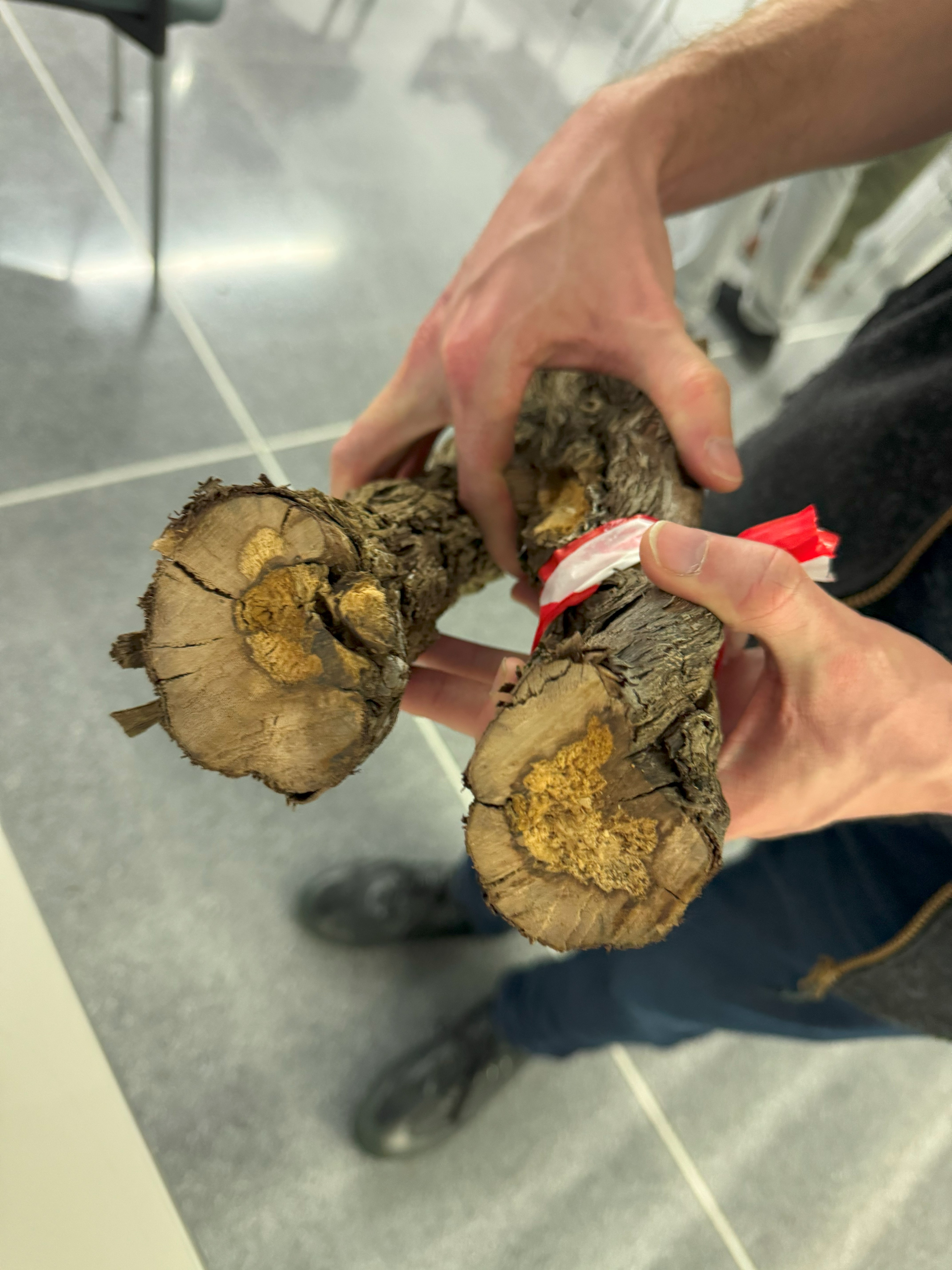
Trunk disease will prevent accurate SWP readings.
Research Library
The FloraPulse grapevine advisory engine draws on 58 sources — 34 peer-reviewed papers plus university extension, industry and vendor guidance. 57 of the 58 citations are verified — against the Crossref or DataCite registry, the live document, or by hand against the publisher's record — and marked ✓. Each entry notes the specific finding it contributes. See these sources in the research library, which spans every crop.
Questions this research answers
- What did Williams & Baeza 2007 find about grapevine irrigation?
- What did Castellarin et al. 2007 find about grapevine irrigation?
- What did Van Leeuwen et al. 2009 find about grapevine irrigation?
- What did Choné et al. 2001 find about grapevine irrigation?
- What did Roby et al. 2004 find about grapevine irrigation?
Peer-reviewed research (34)
- Adams, D.O. (2006). Phenolics and Ripening in Grape Berries. Am. J. Enol. Vitic., 57(3), 249-256. ✓
A review that maps grape berry phenolics onto berry tissue types - which cell types hold anthocyanins, flavonols and tannins - and how their abundance shifts through ripening, so that winemakers can anticipate what will extract. The review itself does not address vine water status or irrigation.
- Almeida, R.P.P. et al. (2013). Ecology and management of grapevine leafroll disease. Frontiers in Microbiology, 4, 94. ✓
A review of grapevine leafroll disease, a complex of Closteroviridae viruses present in every grape region and mainly damaging to wine varieties. It centres on Grapevine leafroll-associated virus 3 and its vectors, frames control in ecological terms, and works through management case studies from South Africa, New Zealand, California and France.
- Bennett, J. et al. (2005). Influence of defoliation on overwintering carbohydrate reserves, return bloom, and yield of mature Chardonnay grapevines. Am. J. Enol. Vitic., 56(4), 386-393. ✓
Defoliating mature Chardonnay vines in cool-climate New Zealand drained overwintering starch: early defoliation left roots at 1.5% starch on a dry-weight basis at budburst versus 17% in untouched vines, and those vines then set up to 50% fewer inflorescences and flowers the following season, lowering yield.
- Blundell, R. & Eskalen, A. (2022). Biological and chemical pruning wound protectants reduce infection of grapevine trunk disease pathogens. California Agriculture, 75(3-4), 128-134. ✓
A UC Davis field trial on Sauvignon blanc tested chemical and biological pruning-wound protectants against Eutypa lata and Neofusicoccum parvum. The fungicide Luna Sensation, the biofungicide Vintec, and a Bio-Tam plus CrabLife Powder combination each protected against at least one pathogen, but most products did not control both at once.
- Casassa, L.F. et al. (2015). Regulated Deficit Irrigation Alters Anthocyanins, Tannins and Sensory Properties of Cabernet Sauvignon Grapes and Wines. Molecules, 20, 7820-7844. ✓
Three seasons of regulated deficit irrigation on Cabernet Sauvignon: against an industry-standard regime, a full-season deficit cut yield 37 percent and an early deficit 18 percent, while a late deficit cost no yield. Skin anthocyanin concentration rose 24 and 18 percent under the full and early deficits, and the wines followed suit.
- Castellarin, S.D. et al. (2007). Transcriptional regulation of anthocyanin biosynthesis in ripening fruits of grapevine under seasonal water deficit. Plant, Cell & Environment, 30, 1381-1399. ✓
Merlot vines held at a midday STEM water potential of -1.2 to -1.4 MPa, against controls kept at -0.2 to -0.6 MPa, finished harvest with 37 to 57 percent more total berry anthocyanin in two consecutive seasons, shifted toward the more hydroxylated and methoxylated forms such as malvidin and peonidin.
- Castellarin, S.D. et al. (2007). Water deficits accelerate ripening and induce changes in gene expression regulating flavonoid biosynthesis in grape berries. Planta, 227, 101-112. ✓
Field Cabernet Sauvignon given a water deficit before or after veraison: both timings increased berry anthocyanin accumulation after veraison, and the early (pre-veraison) deficit also sped up sugar accumulation and the onset of anthocyanin synthesis by turning on the anthocyanin pathway genes earlier and harder.
- Choné, X. et al. (2001). Stem water potential is a sensitive indicator of grapevine water status. Annals of Botany, 87(4), 477-483. ✓
Comparing predawn leaf, midday leaf and midday stem water potential on non-irrigated vines through the season, stem water potential separated vine water status best at both moderate and severe deficit; the gap between stem and leaf values served as an indirect measure of mean leaf transpiration.
- Christensen, L.P., Beede, R.H. & Peacock, W.L. (2006). Fall foliar sprays prevent boron-deficiency symptoms in grapes. California Agriculture, 60(2), 100-103. ✓
In a Fresno County Thompson Seedless trial, a fall foliar boron spray prevented deficiency symptoms better than dormant soil, pre-bloom or bloom sprays: 78% of control clusters showed symptoms, while fall-sprayed vines had the lowest severity at 3%. Fall foliage tolerated 1 lb boron per acre; spring and summer sprays need half that to avoid burn.
- Considine, J.A. & Kriedemann, P.E. (1972). Fruit splitting in grapes: determination of the critical turgor pressure. Australian Journal of Agricultural Research, 23(1), 17-23. ✓
The authors measured how much internal turgor a grape berry withstands before rupture by equilibrating fruit of known osmotic potential in osmotica. Critical turgor, the pressure that split 50% of berries, was about 15 atm in split-prone cultivars and 40 atm in resistant ones; growth regulators shifted it in both directions.
- Daane, K.M. et al. (2012). Biology and Management of Mealybugs in Vineyards. In: Arthropod Management in Vineyards, Springer. ✓
Book chapter reviewing the mealybug species that have become primary vineyard pests worldwide -- grape, obscure, longtailed, citrophilus, vine, citrus, pink hibiscus and Gills mealybugs -- covering their biology and ecology, their role as vectors of grapevine pathogens, and control strategies.
- Flasco, M.T. et al. (2025). A decade of grapevine red blotch disease epidemiology reveals zonal roguing as novel management. npj Viruses, 3, 29. ✓
A decade of monitoring one vineyard: grapevine red blotch disease incidence climbed from 3.9% in 2014 to 36.4% in 2023, spreading fastest near a transmission hotspot and mostly vine to neighboring vine. Because asymptomatic infections drove the spatial clustering, the authors propose zonal roguing - pulling diseased vines plus their neighbors.
- Gadoury, D.M. et al. (2003). Ontogenic resistance to powdery mildew in grape berries. Phytopathology, 93, 547-555. ✓
Clusters of four Vitis vinifera cultivars were inoculated from prebloom to six weeks postbloom; only fruit inoculated within about two weeks of bloom developed severe powdery mildew. Berries acquire ontogenic resistance rapidly after fruit set, weeks before the 8 Brix long assumed, so fungicides should concentrate on that short window.
- Gambetta, J.M. et al. (2021). Sunburn in Grapes: A Review. Frontiers in Plant Science. ✓
Review of sunburn in grapes. Damage comes from excess visible and UV radiation combined with heat, and is made worse by water deficit; what matters is fruit surface temperature rather than air temperature, since direct sun can push the exposed side of a berry 12 to 15 C above air temperature.
- Gouot, J.C. et al. (2019). Grape berry flavonoids: a review of their biochemical responses to high and extreme high temperatures. J. Experimental Botany, 70(2), 397-423. ✓
Review of how high and extreme temperature affect grape berry flavonoids. Across studies that isolate temperature from light and water, high temperature reliably lowers total anthocyanin, while changes in anthocyanin composition and in flavonol and proanthocyanidin levels are far less consistent.
- Holzapfel, B.P., Smith, J.P., Field, S.K. & Hardie, W.J. (2010). Dynamics of Carbohydrate Reserves in Cultivated Grapevines. Horticultural Reviews, 37, 143-211. ✓
A book-chapter review of how grapevines build, store and remobilize carbohydrate reserves in roots, trunk and canes. It covers reserve accumulation and photoassimilate storage, mobilization and use in spring, and the viticultural practices that shift reserve status.
- Kennedy, J.A. et al. (2002). Effect of maturity and vine water status on grape skin and wine flavonoids. Am. J. Enol. Vitic., 53(4), 268-274. ✓
In Cabernet Sauvignon, per-berry anthocyanins, flavonols and pigmented tannin all rose with maturity, while increasing postveraison water deficit produced only small increases in anthocyanins and decreases in flavonols. The authors conclude postveraison deficits act on red wine flavonoids mainly by reducing berry size.
- Kennison, K.R., Wilkinson, K.L., Williams, H.G., Smith, J.H. & Gibberd, M.R. (2007). Smoke-derived taint in wine: effect of postharvest smoke exposure of grapes on the chemical composition and sensory characteristics of wine. Journal of Agricultural and Food Chemistry, 55(26), 10897-10901. ✓
Verdelho grapes were exposed to straw smoke for one hour after harvest and then fermented. A sensory panel reliably separated the resulting wines, calling them smoky, dirty, earthy, burnt and smoked meat, and those wines held guaiacol, 4-methylguaiacol, 4-ethylguaiacol, 4-ethylphenol, eugenol and furfural, all absent from controls.
- Kliewer, W.M. & Dokoozlian, N.K. (2005). Leaf area/crop weight ratios of grapevines: Influence on fruit composition and wine quality. Am. J. Enol. Vitic., 56(2), 170-181. ✓
Across four California cultivars, the leaf area to crop weight ratio needed for maximum soluble solids, berry weight and berry color was 0.8 to 1.2 square meters per kg of fruit on single-canopy trellises, but only 0.5 to 0.8 on horizontally divided canopies. It also gives balance ranges for yield to pruning weight and canopy density.
- Maas, E.V. & Hoffman, G.J. (1977). Crop salt tolerance — current assessment. Journal of the Irrigation and Drainage Division, ASCE, 103(2), 115-134. ✓
The standard crop salt-tolerance tables. Grape (Vitis spp.) is rated MS, moderately sensitive: yield starts declining above a saturated-paste soil salinity (ECe) of 1.5 mmho/cm, equivalent to dS/m, and drops about 9.6% for each additional unit above that. The grape entry carries a footnote that its tolerance is based on growth rather than yield.
- Martinez-Luscher, J. et al. (2020). Mitigating heat wave and exposure damage to Cabernet Sauvignon wine grape. Frontiers in Plant Science. ✓
Cabernet Sauvignon grown at 40 or 80 percent ETc with or without fruit-zone shade: exposed clusters ran 3.9 C hotter at their maximum, and a four-day heat wave 21 days before harvest damaged 25 percent of exposed clusters at both irrigation levels. Even undamaged exposed berries lost anthocyanin and flavonols.
- Matthews, M.A. & Anderson, M.M. (1988). Fruit ripening in Vitis vinifera L.: responses to seasonal water deficits. Am. J. Enol. Vitic., 39(4), 313-320. ✓
Cabernet franc in California's North Coast under pre- or post-veraison deficits, roughly 0.3 MPa below the well-watered vines on midday LEAF water potential. Every treatment that withheld water raised juice and skin phenolics and skin anthocyanins, with no effect on the onset of veraison or ripening duration.
- Mori, K. et al. (2007). Loss of anthocyanins in red-wine grape under high temperature. J. Experimental Botany, 58(8), 1935-1945. ✓
In Cabernet Sauvignon, a high-temperature regime peaking at 35 C cut total skin anthocyanin to less than half that of 25 C controls. Isotope-labelling showed much of the loss was degradation of anthocyanin already made, not only reduced biosynthesis, since the biosynthetic genes were not strongly down-regulated.
- Nair, N.G. & Allen, R.N. (1993). Infection of grape flowers and berries by Botrytis cinerea as a function of time and temperature. Mycological Research, 97(8), 1012-1014. ✓
Controlled wetness and temperature tests found Botrytis cinerea infected grape flowers best near 23.7 C and berries near 20.8 C. At those optima, 63 percent infection needed only 1.3 h of wetness on flowers but 13.9 h on berries, and the wetness requirement grew as temperature moved away from the optimum.
- Ojeda, H. et al. (2001). Influence of water deficits on grape berry growth. Vitis, 40(3), 141-145. ✓
Early and late water deficits applied to Syrah did not reduce pericarp cell division; smaller berries came entirely from reduced cell volume. The size loss caused by an early deficit, between flowering and veraison, was irreversible even after water was restored.
- Poni, S. et al. (2006). Effects of early defoliation on shoot photosynthesis, yield components, and grape composition. Am. J. Enol. Vitic., 57(4), 397-407. ✓
Removing the six basal leaves before bloom in Sangiovese and Trebbiano cut fruit set, cluster weight, berry number and cluster compactness, giving looser clusters less prone to rot, while whole-shoot photosynthesis was essentially unchanged because laterals compensated. Brix rose in both cultivars, anthocyanins and phenolics in Sangiovese.
- Roby, G. et al. (2004). Berry size and vine water deficits as factors in winegrape composition: Anthocyanins and tannins. Aust. J. Grape Wine Res., 10, 100-107. ✓
Cabernet Sauvignon berries from high, control and low water status vines were sorted into six size classes. Water deficit raised skin tannin and anthocyanin both per berry and per unit mass, and that water-status effect was larger than the effect of berry size itself; seed tannin was not significantly affected by water status.
- Rogiers, S.Y. et al. (2012). Stomatal response of an anisohydric grapevine cultivar to evaporative demand, available soil moisture and abscisic acid. Tree Physiology, 32(3), 249-261. ✓
In Semillon, an anisohydric variety, midday leaf water potential depended not only on soil moisture but on the vapor pressure deficit at the moment of measurement. In drip-irrigated vineyards predawn leaf water potential tracked night-time VPD, because vines rehydrated incompletely on high-VPD nights.
- Rogiers, S.Y., Coetzee, Z.A., Walker, R.R., Deloire, A. & Tyerman, S.D. (2017). Potassium in the Grape (Vitis vinifera L.) Berry: Transport and Function. Frontiers in Plant Science, 8, 1629. ✓
A review of potassium in the grape berry. K+ is the most abundant cation in the berry and accumulates rapidly during ripening alongside sugar; the authors propose a mechanistic model of its role in phloem transport, turgor and membrane stability, and note that high K strongly influences juice pH and so wine acidity and color.
- Stavrinides, M.C. et al. (2010). Plant Water Stress, Leaf Temperature, and Spider Mite (Acari: Tetranychidae) Outbreaks in California Vineyards. Environ. Entomology, 39(4), 1232-1241. ✓
Across eight California vineyards, south-facing leaf temperature rose about 5.3 degrees C for every 1 MPa drop in leaf water potential, and Pacific spider mite peaks tracked how often leaves exceeded 31 degrees C. The authors therefore caution that regulated deficit irrigation be used carefully where that mite is a risk.
- Van Leeuwen, C. & Destrac-Irvine, A. (2017). Modified grape composition under climate change conditions requires adaptations in the vineyard. OENO One, 51(2), 147-154. ✓
Review of how a warming, drying climate changes grape composition: earlier phenology and hotter ripening give more sugar and less organic acid, while increased drought halts shoot growth sooner, shrinks berries, raises skin phenolics and lowers malic acid. Adaptation levers include plant material, canopy management, harvest timing and irrigation.
- Van Leeuwen, C. et al. (2009). Vine water status is a key factor in grape ripening and vintage quality for red Bordeaux wine. J. Int. Sci. Vigne Vin, 43(3), 121-134. ✓
Four Bordeaux vintages on three soil types: water deficit stopped shoot growth earlier, held berry weight down and raised berry anthocyanin, while sugar peaked under mild deficit only. Stem water potential and carbon isotope discrimination both tracked vine water status well, and vintage quality followed deficit intensity more than temperature.
- Wenter, A., Andreotti, C., Zanotelli, D. & Keller, M. (2025). Alleviating Water Stress at Veraison May Trigger Berry Shrivel Disorder in Susceptible Grapevines. American Journal of Enology and Viticulture, 76(1), 0760010. ✓
In deficit-irrigated Cabernet Sauvignon in arid southeastern Washington, irrigation was suspended through the lag phase and restored at veraison. Rewatering at 50% veraison, but not at 5% veraison, significantly increased berry shrivel incidence, so the authors advise avoiding abrupt swings in soil moisture and temperature near veraison.
- Williams, L.E. & Baeza, P. (2007). Relationships among ambient temperature and vapor pressure deficit and leaf and stem water potentials of fully irrigated, field-grown grapevines. Am. J. Enol. Vitic., 58(2), 173-181. ✓
Across four wine grape cultivars at five California sites, leaf and stem water potential of fully irrigated vines varied linearly with vapor pressure deficit (R2 = 0.74 for leaf). At 2 and 5 kPa VPD the non-stressed baselines were about -0.65 and -0.89 MPa midday leaf, and -0.37 and -0.57 MPa stem.
University & extension guidance (19)
- Allen, R.G., Pereira, L.S., Raes, D. & Smith, M. (1998). Crop evapotranspiration — Guidelines for computing crop water requirements. FAO Irrigation and Drainage Paper 56. ✓
FAO Irrigation and Drainage Paper 56 supplies the standard crop coefficients used to turn reference ET into vineyard water use. For wine grapes it lists Kc initial 0.30, Kc mid-season 0.70 and Kc end 0.45, with a mean maximum crop height of 1.5 to 2 m, plus typical growth-stage lengths by region.
- CDFA FREP. California Fertilization Guidelines — Grapevines. ✓
California's official fertilization guideline for grapevines: deficiency and excess symptoms, soil and petiole test interpretation, and rate and timing guidance for N, P, K, Ca, Mg and micronutrients. It puts the optimal full-bloom petiole nitrate-N at 500 to 1200 ppm, with over 2000 to 2400 ppm tied to excess growth or reduced fruit set.
- CDFA FREP. Grapevine Nitrogen Uptake & Partitioning. ✓
The nitrogen companion to CDFA's grapevine guideline: vine N uptake is relatively low from budbreak to bloom and high from bloom to veraison, roughly 30% of total vine N sits in the clusters, and California wine grape harvest removed about 2.6 lbs N per ton of fresh fruit in the trial summarized.
- Gubler, W.D. et al. (1999). Control of Powdery Mildew Using the UC Davis Powdery Mildew Risk Index. ✓
Sets out the UC Davis powdery mildew risk index: add 20 points for each day with at least 6 hours between 21 and 30 C, subtract 10 for a day without that or with a maximum above 35 C. An index of 60 to 100 means the pathogen reproduces every 5 days; index-driven spraying cut 2 to 3 applications a season with equal or better control.
- MSU Extension. How Cold Can Grapes Go? — Spring frost critical temperatures. ✓
MSU Extension page collecting published critical spring-frost temperatures for grapes by bud stage, from Washington State (Concord) and Rutgers (wine grape) freezer tests. It warns those numbers can be optimistic in humid regions, because Howell's work found wet buds are killed at warmer temperatures than dry ones.
- NC State Extension. Spring Frost Control — NC Winegrape Grower's Guide, Ch. 11. ✓
NC State winegrape guide chapter on active spring frost control. It matches wind machines, heaters, over-vine sprinklers and helicopters to hoar frost, black frost and frost/freeze events, and cautions that no mechanical method should be run when winds exceed 10 mph and that wind machines cannot lift temperature more than 1 to 3 degrees.
- Penn State Extension. Understanding and Preventing Spring Frost and Freeze Damage to Grapes. ✓
Penn State Extension primer on post-budbreak frost. It separates radiative frosts, which can be fought, from advective freezes, where wind machines are useless, and covers passive measures (air drainage, higher training, delayed or double pruning) plus active ones; wind machines give roughly 1 to 3 F and need an inversion.
- Prichard, T.L. (2012). Winegrape Irrigation Scheduling Using Deficit Irrigation Techniques. UC Cooperative Extension. ✓
UC Cooperative Extension guide to scheduling winegrape deficit irrigation. It grades vine stress by midday LEAF water potential: no stress above -10 bars, mild -10 to -12, moderate -12 to -14, high -14 to -16, severe beyond -16, and uses that threshold to set the start of irrigation before applying a fraction of full water use.
- UC Davis Dept. of Viticulture & Enology. Wildfire and Smoke Exposure Resources. ✓
UC Davis Viticulture and Enology's wildfire and smoke-exposure resource hub: providers that run smoke-exposure testing on grapes and wine, the standard grape sampling protocol for growers, a micro-fermentation protocol for assessing risk before harvest, a smoke-exposure FAQ, and links to the West Coast Smoke Exposure Task Force.
- UC IPM. Botryosphaeria Dieback — Grape Pest Management Guidelines. ✓
UC IPM's guideline for Botryosphaeria (Bot) dieback, the most common and widespread trunk disease in California. It produces no distinctive foliar symptom; shoots from an infected spur simply wilt and die back during the season. Winter-rain spores infect pruning wounds, and pruning as late as possible in the dormant period cuts that risk.
- UC IPM. Botrytis Bunch Rot — Grape Pest Management Guidelines. ✓
UC IPM guideline for Botrytis bunch rot. Flowers are infected at bloom through the stigma and calyptra scar and the fungus then stays latent until sugar rises; late-season infection is worst above 92 percent relative humidity with free moisture at 58 to 82 F. Removing basal leaves right after berry set cuts incidence and severity.
- UC IPM. Eutypa Dieback — Grape Pest Management Guidelines. ✓
UC IPM's guideline for Eutypa dieback. Spores are released during winter rain and infect fresh pruning wounds, so the effective controls are preventive: delaying pruning to February or later, double pruning, and wound protectants, ideally started in vineyards under five years old, since an established wood canker cannot be cured by fungicide.
- UC IPM. Pest Management Guidelines: Grape. ✓
The landing page for the University of California's official grape pest management guidelines, UC ANR Publication 3448: year-round IPM programs organized by phenological stage for table grapes and for wine and raisin grapes, plus per-pest sections on diseases, insects, mites, nematodes and weeds with California monitoring and treatment guidance.
- UC IPM. Phomopsis Cane and Leafspot — Grape Pest Management Guidelines. ✓
UC IPM's guideline for Phomopsis cane and leafspot. Infection requires free moisture, so the disease is worst in northern California districts where spring rain follows budbreak; spores splash from overwintering pycnidia on old canes and spurs onto new shoots. Control is dormant lime sulfur plus protectant sprays timed to post-budbreak rain.
- UC IPM. Pierce's Disease — Grape Pest Management Guidelines. ✓
UC IPM's guideline for Pierce's disease, caused by the xylem-limited bacterium Xylella fastidiosa and spread by sharpshooters. Of direct relevance to irrigation: hot climates accelerate symptom development because vine water stress is more severe even when soil moisture is adequate, and vines infected before June rarely recover.
- UC IPM. Powdery Mildew — Grape Pest Management Guidelines. ✓
UC IPM guideline for grape powdery mildew. Ascospore infection follows a wetting event plus 10 to 13 hours of leaf wetness at 50 to 80 F; the fungus grows best at 70 to 85 F and slows above 95 F. Spray intervals follow the UC Davis risk index, and treatment may stop at 12 Brix on wine grapes.
- UC IPM. Vine Mealybug — Grape Pest Management Guidelines. ✓
UC IPM guideline for vine mealybug, Planococcus ficus. It runs three to seven generations a year (two to three on the coast, five to seven in the lower San Joaquin Valley), fouls clusters with honeydew and sooty mold, and transmits grapevine leafroll-associated viruses. Monitoring pairs pheromone traps for males with vine inspection.
- UC IPM. Webspinning Spider Mites — Grape Pest Management Guidelines. ✓
UC IPM guideline for the webspinning spider mites of grape (Pacific, twospotted, Willamette). Pacific spider mite is the main San Joaquin Valley pest and favors the hotter, drier part of the season and the upper canopy; cultural control centers on suppressing road dust and irrigating so vines are not stressed.
- Williams, L.E. Deficit irrigation of wine grape vineyards. UC ANR. ✓
UC Davis extension paper on deficit irrigating winegrape vineyards. Williams starts seasonal irrigation when midday LEAF water potential drops to about -1.0 MPa (-10 bars) in the San Joaquin Valley and about -1.2 MPa (-12 bars) or slightly lower in coastal vineyards, then applies a set fraction of estimated ETc.
Industry & agency resources (2)
- Lodi Growers. Erratic Budbreak and Variable Shoot Emergence. ✓
An extension article on why budbreak and shoot emergence come in unevenly: bud necrosis from excessive vigor or shading, freeze damage, cold or dry-soil root injury, low reserves in young vines, cutworms, and too little winter chill - given as under 200 to 300 hours below 45 F - which can stretch budbreak over several weeks.
- Prichard, T., Smith, R. & Verdegaal, P. (UCCE). Regulated Deficit Irrigation Management for Winegrapes (hosted by Vineyard Team). ✓
UC Cooperative Extension guide to regulated deficit irrigation in winegrapes. It puts the typical irrigation start threshold for red varieties at a midday LEAF water potential of -13 to -15 bars (-10 to -13 for whites), then applies about 50 to 60 percent of full vine water use.
Vendor documentation (3)
- Advanced Viticulture. Micronutrients — You Should Sweat the Small Stuff. ✓
A practical guide to vineyard micronutrients - B, Zn, Mn, Fe, Cu, Mo and S - covering what each does and how to correct it. Boron gets the most caution because deficiency and toxicity sit close together: bloom petiole boron above 35 ppm is adequate and about 50 ppm ideal, while values approaching 100 ppm mean applications should stop.
- Advanced Viticulture. Season of Nutrition — Vineyard Nutrient Management. ✓
A consultant's stage-by-stage vineyard fertilizer program - budburst, pre-bloom, post-set, lag phase, ripening and post-harvest - with the reasoning behind each timing: foliar micronutrients before bloom, most macronutrients right after set, and K avoided during ripening because it can raise juice K and pH.
- eVineyard. Evaluating Grapevine Winter Chilling Requirements.
A grower-facing explainer on grapevine winter chilling requirements: what chilling hours are, when they accumulate during dormancy, and why cultivars differ in how much winter chill they need before buds break normally in spring.
Additional notes & resources
- Scheduling irrigation with a pressure chamber. Part 1. Part 2.
- What it’s like to have real time plant stress