
Kiwi
ExperimentalThe sensor gives usable readings here, but the dataset is thin and there are no published thresholds. Sold for research and supervised field trials only — not for commercial irrigation scheduling. Growers: stick to the Validated list.
Performance
Recommended for experimental and initial agricultural use. Initial testing with 7mm sensors showed mostly good results and decent correlation with the pressure chamber.
Installation Tips
- Will need to use the 7mm probes with the c-clamp installation method
Data & Validation
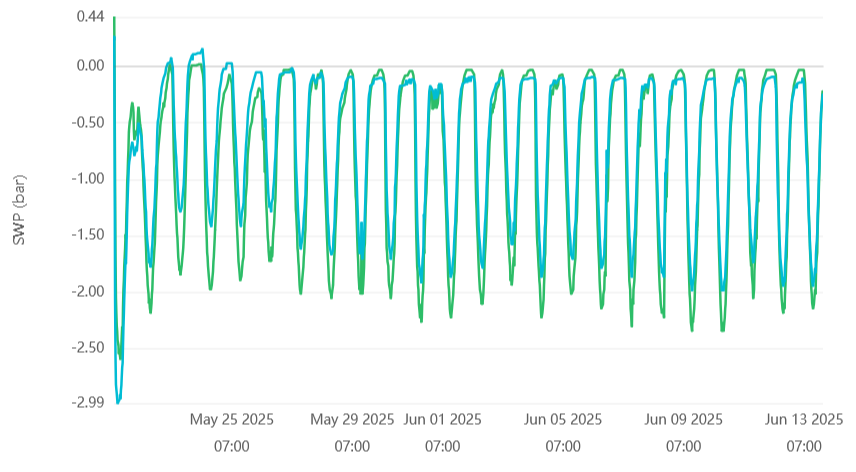
Quinco Kiwi trial
Research Library
The FloraPulse kiwifruit advisory engine draws on 13 sources — 9 peer-reviewed papers plus university extension, industry and vendor guidance. All 13 citations are verified — against the Crossref or DataCite registry, the live document, or by hand against the publisher's record — and marked ✓. Each entry notes the specific finding it contributes. See these sources in the research library, which spans every crop.
Questions this research answers
- What did Calabritto et al. 2024 find about kiwifruit irrigation?
- What did Calderón-Orellana et al. 2025 find about kiwifruit irrigation?
- What did Di Biase et al. 2025 find about kiwifruit irrigation?
- What did Chartzoulakis et al. 1995 find about kiwifruit irrigation?
- What did Calabritto et al. 2025 find about kiwifruit irrigation?
Peer-reviewed research (9)
- Calabritto, M., Mininni, A.N., Di Biase, R., Petrozza, A., Summerer, S., Cellini, F. & Dichio, B. (2025). Physiological and image-based phenotyping assessment of waterlogging responses of three kiwifruit rootstocks and grafting combinations. Frontiers in Plant Science, 16, 1499432. ✓
A nine-day pot waterlogging trial on three kiwifruit rootstocks. On the sensitive D1 and Hayward rootstocks stomatal conductance and transpiration fell significantly from day 4, and photosynthesis was already down 47 to 63 percent by day 4, while the Actinidia macrosperma rootstock stayed close to its well-watered controls throughout.
- Calabritto, M., Mininni, A.N., Di Biase, R., Pietrafesa, A. & Dichio, B. (2024). Spatio-temporal dynamics of root water uptake and soil-moisture thresholds for precision irrigation in a Mediterranean yellow-fleshed kiwifruit orchard. Frontiers in Plant Science 15:1472093. ✓
In a mature yellow-fleshed kiwifruit orchard in southern Italy, well-watered vines held midday stem water potential between -0.4 and -0.7 MPa, and stomatal conductance began to fall significantly once midday stem water potential dropped past about -0.8 MPa. Root water uptake was concentrated in the top 30 cm of soil.
- Calderón-Orellana, A. et al. (2025). Late Water Deficits Improve Intrinsic Water Use Efficiency, Fruit Maturity, and Acceptability in Yellow-Fleshed Kiwifruit cv. Soreli. Plants 14(18):2843. ✓
Two seasons of late-season deficit irrigation on 'Soreli' kiwifruit in central Chile: cutting irrigation entirely for the three weeks before harvest lowered stem and leaf water potential but raised intrinsic water use efficiency, improved water productivity by up to 20 percent, and added up to 2.0 Brix with no loss of firmness or yield.
- Chartzoulakis, K., Therios, I., Misopolinos, N. & Noitsakis, B. (1995). Growth, ion content and photosynthetic performance of salt-stressed kiwifruit plants (cv. 'Hayward'). Irrigation Science, 16, 23-28. ✓
Rooted 'Hayward' kiwifruit cuttings in sand-perlite were irrigated for 60 days with 0 to 30 mM added NaCl. Plant dry weight and leaf area were already reduced significantly at 10 mM NaCl, leaf chloride rose above that level, and photosynthesis fell as leaf chloride rose. The authors conclude kiwifruit is a salt-sensitive plant.
- Di Biase, R., Calabritto, M., Mininni, A.N., Montanaro, G. & Dichio, B. (2025). Microtensiometer-based trunk water potential as a plant water status indicator in kiwifruit under different soil water availability. Irrigation Science 43(4):937-954. ✓
A two-year Italian kiwifruit trial tracked trunk water potential with an embedded microtensiometer under 100, 50 and 25 percent irrigation. Trunk potential tracked pressure-chamber midday stem water potential (R2 = 0.78) but changed slope below about -1.6 MPa stem; in well-irrigated vines the daily swing was driven mainly by VPD.
- Judd, M.J., McAneney, K.J. & Wilson, K.S. (1989). Influence of water stress on kiwifruit growth. Irrigation Science, 10(4), 303-311. ✓
Young kiwifruit vines grown over two seasons in a water-controlled trench: fruit expansion ceased once predawn leaf water potential fell below -0.1 MPa, and mean fruit size at harvest ranged from 60 to 130 cm3 across stress treatments. Leaf turgor came back within 24 hours of rewatering even after severe, prolonged stress.
- Li, D., Xie, X., Liu, X., Cheng, C., Guo, W., Zhong, C. & Atak, A. (2022). Effects of Short-Term High Temperature on Gas Exchange in Kiwifruits (Actinidia spp.). Biology, 11(11), 1686. ✓
Greenhouse gas-exchange work on Actinidia species and cultivars of differing ploidy: net photosynthesis of commercial cultivars was strongly inhibited once temperature exceeded 44.5 C, and leaves were irreversibly damaged at 52 C. Tetraploids were the most heat-tolerant, hexaploids had the highest net photosynthetic rate.
- McAneney, K.J., Judd, M.J. & Trought, M. (1984). Wind damage to kiwifruit in relation to windbreak performance. NZ J. Agric. Res. 27(2). ✓
A New Zealand study of wind damage to T-bar trellised kiwifruit: loss of export-quality fruit rose with distance downwind of both natural and artificial windbreaks, even at shelter spacings the literature calls adequate. Wind-rub rejects ran 3 to 10 percent beside natural shelter versus 30 to 44 percent 3 to 4 rows downwind of artificial shelter.
- Zhao, T. et al. (2017). The Differentiation of Chilling Requirements of Kiwifruit Cultivars Related to Ploidy Variation. HortScience, 52(12), 1676-1679. ✓
Nine kiwifruit cultivars at three ploidy levels were scored with the Dynamic, Utah and chilling-hours models. Vegetative budbreak required 222 to 853 chilling hours and floral emergence 655 to 1138 chilling hours. Requirement rose with ploidy: lowest in diploids, highest in hexaploids, tetraploids intermediate.
University & extension guidance (4)
- Allen, R.G., Pereira, L.S., Raes, D. & Smith, M. (1998). Crop evapotranspiration — Guidelines for computing crop water requirements. FAO Irrigation and Drainage Paper 56. ✓
FAO-56 Table 12 lists kiwi single crop coefficients of Kc ini 0.40, Kc mid 1.05 and Kc end 1.05, with a mean maximum plant height of 3 m. The mid and end values assume a subhumid climate (minimum daytime RH about 45 percent, wind about 2 m/s) and must be adjusted for drier, more humid or windier sites.
- EPPO Datasheet: Pseudomonas syringae pv. actinidiae (Psa) — kiwifruit bacterial canker. Rain/humidity/irrigation/frost-driven; longer canopy wetness raises infection risk. ✓
The EPPO datasheet on kiwifruit bacterial canker (Pseudomonas syringae pv. actinidiae): high humidity and rain disperse the bacteria, frost injury opens extra entry points, and disease advances fastest at 15 to 22 C. Management advice favours drip over sprinkler irrigation and avoiding anything that keeps the canopy wet for long.
- UC ANR Small Farms Network — Kiwifruit / Kiwifruit Production in California (Beutel). CA calendar, frost, chill, and irrigation-water quality limits (Cl<70, Na<50, B<0.25 ppm, ECw<0.75 dS/m). ✓
A UC extension overview of California kiwifruit growing by James Beutel, covering climate, chill, frost, trellis, costs and irrigation. It gives safe irrigation-water limits of chloride under 70 ppm, sodium under 50 ppm, boron under 0.25 ppm and EC under 0.75, and advises watering bearing vines three to four times a week.
- UC IPM Pest Management Guidelines: Kiwifruit — Phytophthora Root and Crown Rot (UC ANR Pub 3449; Adaskaveg, Michailides, Gubler). Raised berms; irrigation sets ≤6 h; drain between sets. ✓
The UC IPM kiwifruit guideline for Phytophthora root and crown rot: prolonged soil saturation is what lets the pathogen infect roots, so it advises planting on raised berms in well-drained soil, keeping any single irrigation under six hours where the disease occurs, and letting soil drain before the next set.