
Oak
ExperimentalThe sensor gives usable readings here, but the dataset is thin and there are no published thresholds. Sold for research and supervised field trials only — not for commercial irrigation scheduling. Growers: stick to the Validated list.
Performance
Recommended for research use, not for irrigation decisions. Oak is ring-porous — the conductive xylem is a thin outer band — so the sensor must sit shallow, in that outermost ring; use the 7mm probe, which gives a consistently shallow depth. The wounding response is the main risk: initial testing showed sensors working well for about 10 days before the reading stuck at zero SWP, and a daily minimum that keeps drifting later into the night across a multi-day record means the site is closing and the sensor needs reinstalling. Not formally validated, so we cannot guarantee a result in oak — and a mature deficit oak can run past the roughly -35 bar (-3.5 MPa) sensor rating.
Installation Tips
- Ring-porous: install shallow, in the outermost xylem ring. The 7mm probe is strongly recommended because it holds a consistently shallow depth — a sensor that goes in a touch deep gives a damped swing or an offset.
- A late-afternoon daily minimum is normal in oak. The sensor lags the tree by an hour or two, and on a big trunk the stored water pushes the minimum later still.
Known Issues
- The wounding response can flood or seal the install site, leaving the sensor stuck at zero SWP. Reinstall into fresh sapwood; a daily minimum that keeps drifting later into the night across several days is the early signature.
- Mature deficit oaks can genuinely run past the sensor rating of about -35 bar (-3.5 MPa), which reads as over-range and can cavitate the sensor.
Data & Validation
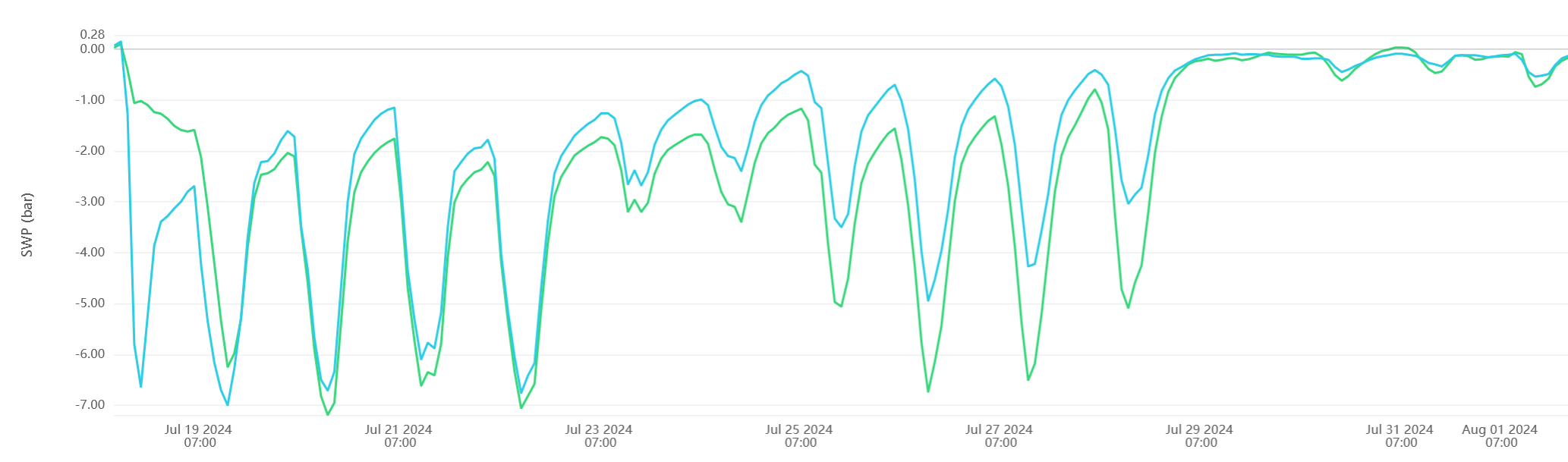
Oak sensor data showing proper shallow installation results
References
- Using midday stem water potential to assess irrigation needs of landscape valley oaks