
Prune/Plum
ValidatedCompared against the pressure chamber over multiple seasons and sites. Solid enough to drive commercial irrigation decisions.
Performance
Excellent. Recommended for commercial use. Sensor data generally matches the pressure chamber. Thoroughly validated and used commercially.
Installation Tips
- Install after leaf out, on a 2” branch. Installation into main trunk can be difficult if the bark is thick. Big and small sensors can work well.
- Sensors should be reinstalled after the winter, otherwise measured SWP will read too wet.
Known Issues
- Sensor install site can get blocked and sensor will read too wet, with little to no diurnal pattern. Reinstall.
- Sensors can get disconnected from xylem due to breaks in the mating compound. The sensors will then read very negative values during hot part of day. Reinstall.
- Very old or diseased prune trees will sometimes give nonsensical data, such as reading the lowest SWP at night. If this happens, sensors should be installed in a different tree.
Data & Validation
Prune sensor data showing typical SWP patterns
Research Library
The FloraPulse prune advisory engine draws on 48 sources — 8 peer-reviewed papers plus university extension, industry and vendor guidance. All 48 citations are verified — against the Crossref or DataCite registry, the live document, or by hand against the publisher's record — and marked ✓. Each entry notes the specific finding it contributes. See these sources in the research library, which spans every crop.
Questions this research answers
- What did Lampinen et al. 2001 find about prune irrigation?
- What did Lampinen et al. 1995 find about prune irrigation?
- What did Shackel 2011 find about prune irrigation?
- What did McCutchan & Shackel 1992 find about prune irrigation?
- What did Michailides & Morgan 1997 find about prune irrigation?
Peer-reviewed research (8)
- Lampinen, B.D., Shackel, K.A., Southwick, S.M. & Olson, B. (2001). Deficit irrigation strategies using midday stem water potential in prune. Irrigation Science, 20, 47-54. ✓
In a 3-year French prune trial, letting midday stem water potential decline to about -1.5 MPa (-15 bars) by harvest supplied only about 57% of estimated seasonal crop water needs without reducing dry fruit yield or economic return, and cut fruit drop, side-cracking and fruit hydration ratio.
- Lampinen, B.D., Shackel, K.A., Southwick, S.M., Olson, B. & Yeager, J.T. (1995). Sensitivity of yield and fruit quality of French prune to water deprivation at different fruit growth stages. JASHS, 120(2), 139-147. ✓
Water deprivation at different French prune fruit growth stages was studied over 3 years; withholding water through all of stage II raised return bloom and lowered fruit hydration ratio, but on shallow soil the faster, more severe stress increased fruit drop and gave the lowest dry yields, so effects depended on soil depth.
- Luedeling, E., Zhang, M. & Girvetz, E.H. (2009). Climatic changes lead to declining winter chill for fruit and nut trees in California during 1950-2099. PLoS ONE, 4(7), e6166. ✓
Modeling of California winter chill from 1950 to 2099 projected steep declines under every emissions scenario, with the area of safe winter chill for many tree species or cultivars falling 50-75 percent by mid-century and 90-100 percent by late century. Areas meeting the >700 chilling hours plums need should nearly disappear.
- McCutchan, H. & Shackel, K.A. (1992). Stem-water potential as a sensitive indicator of water stress in prune trees. JASHS, 117(4), 607-611. ✓
In field-grown French prune, midday stem water potential varied less than leaf water potential and detected the mild stress of a 50% soil-moisture-depletion irrigation interval that leaf water potential missed. Unlike soil water content, it related to orchard ET independently of soil texture, tracking stomatal conductance.
- Michailides, T.J. & Morgan, D.P. (1997). Influence of fruit-to-fruit contact on the susceptibility of French prune to infection by Monilinia fructicola. Plant Disease, 81, 1416-1424. ✓
In eight commercial French prune orchards, 43 to 69% of brown rot infections were in clustered rather than solitary fruit. Fruit-to-fruit contact surfaces had cracked, thin cuticles, much larger microcracks and little epicuticular wax, and Monilinia fructicola germinated faster and infected at higher rates there.
- Olson, W., Uriu, K., Carlson, R., Krueger, W. & Pearson, J. (1987). Correcting potassium deficiency in prune trees is profitable. California Agriculture, 41(5-6), 20-21. ✓
A 1980-83 Butte County prune trial found that trees with no potassium deficiency symptoms averaged about $1,775 per acre in crop value versus about $1,070 for trees with only slight symptoms, and that a single soil potash application costing under $300 per acre corrected the deficiency for three to four years.
- Proebsting, E.L. & Mills, H.H. (1978). Low temperature resistance of developing flower buds of six deciduous fruit species. JASHS, 103(2), 192-198. ✓
Controlled-freezing tests of flower buds in six deciduous fruit species found the same pattern in all: the 50 percent kill temperature rose to near -3 C by the end of bud development, and the gap between 10 and 90 percent kill narrowed to 1 to 2 C in the later stages. It is the source of the standard Italian prune critical-temperature table.
- Shackel, K.A. (2011). A plant-based approach to deficit irrigation in trees and vines. HortScience, 46(2), 173-177. ✓
A review of plant-based deficit irrigation in grape, almond, prune, pear and cherry, arguing midday stem water potential is the reliable field measure of stress; in prune the author's group used it to cut irrigation by roughly half while maintaining productivity, referenced against a fully irrigated baseline predicted from vapor pressure deficit.
University & extension guidance (36)
- Allen, R.G., Pereira, L.S., Raes, D. & Smith, M. (1998). Crop evapotranspiration — Guidelines for computing crop water requirements. FAO Irrigation and Drainage Paper 56. ✓
The FAO reference-ET standard, computing crop water use as ETc = Kc x ETo. Its Table 12 places plums in the stone fruit group, with Kc initial/mid/end of 0.45/0.90/0.65 for orchards with no ground cover and killing frost, rising to 0.80/1.15/0.85 with active ground cover and no frost.
- Buchner, R.P. (ed., 2012). Prune Production Manual. UC ANR Publication 3507. ✓
The UC ANR Prune Production Manual is the 320-page commercial-grower reference for California prune, with chapters on industry overview, prune biology, soils, varieties, irrigation and fertilization, and pest management. It is the horticultural source UC and CDFA prune guidelines cite most often.
- CDFA FREP. California Fertilization Guidelines — Prune and Plum. ✓
CDFA's fertilization guideline for prune and plum covers N, P, K and micronutrients with soil and leaf sampling protocols, critical values and timings. It notes prunes are heavy potassium feeders needing more K than any other nutrient, and that K deficiency cuts fruit size and soluble solids and raises the drying ratio.
- Fulton, A. Advanced SWP Interpretation in Prune. Sacramento Valley Orchards, UC Cooperative Extension. ✓
UCCE advanced guideline that reads prune midday stem water potential relative to the fully irrigated baseline rather than in absolute bars: the target band is 2 to 8 bars below baseline (roughly -6 to -20 bars absolute), and the page carries the baseline lookup table by air temperature and relative humidity.
- Fulton, A., Buchner, R. & Niederholzer, F. (2015). Drought Tip: Drought Strategies for California Prune Production. UC ANR Publication 8520. ✓
The UC ANR Drought Tip for prune, laying out regulated deficit irrigation for water shortages ranging from mild to keep-the-trees-alive. It states that a Sacramento Valley prune orchard yielding 3 to 4 dry tons per acre uses about 42 inches of water (3.5 acre-feet) per acre per year.
- Fulton, A., Grant, J., Buchner, R. & Connell, J. (2014). Using the Pressure Chamber for Irrigation Management in Walnut, Almond and Prune. UC ANR Publication 8503. ✓
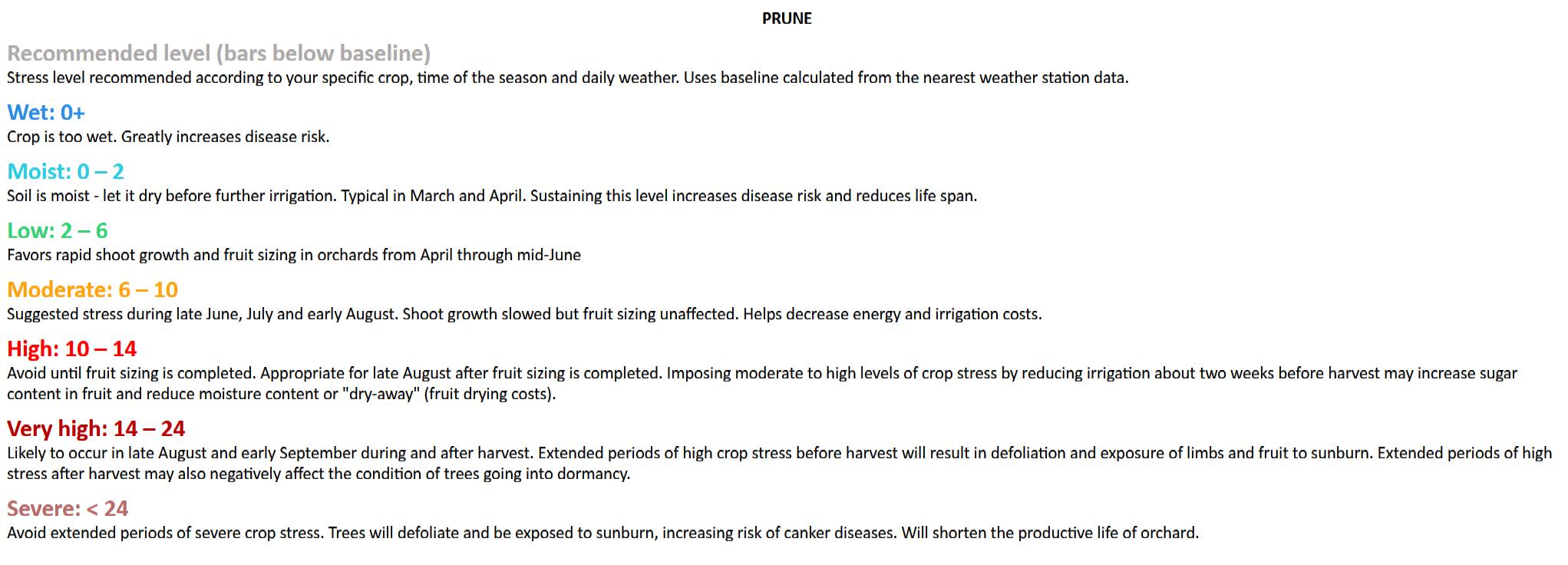
The UC ANR manual on measuring midday stem water potential and using it to schedule irrigation in walnut, almond and prune. Its prune table treats -8 to -12 bars as low to mild stress for April through mid-June, -12 to -16 bars as appropriate from late June into early August, and -16 to -20 bars only once fruit sizing is complete.
- Ingels, C., Bugg, R.L., McGourty, G. & Christensen, L.P. (1998). Cover Cropping in Vineyards: A Grower's Handbook. UC ANR Publication 3338. ✓
UC ANR's cover cropping handbook is a 168-page grower reference on how cover crops affect vineyard performance and promote ecological stability, combining research background with how-to instructions for species selection and field application. It is aimed at growers, managers, consultants and pest control advisers.
- Milliron, L., Niederholzer, F. et al. (2021). Pre- and Post-Harvest Irrigation Management in Prune. Sacramento Valley Orchards. ✓
UCCE pre- and post-harvest prune guide: hold midday stem water potential at -12 to -16 bars from late June to the preharvest cutoff to slow shoot growth without slowing fruit sizing, cut water a week or two before harvest to reach -16 to -20 bars for better dry-away and less bark injury, then recover to -12 to -16 bars.
- Milliron, L., Pierce, C. & Niederholzer, F. (2025). Prune Orchard Pre- and Post-Harvest Irrigation Management. Sacramento Valley Orchards. ✓
The 2025 UCCE update on prune irrigation: -8 to -12 bars midday stem water potential from April to mid-June, -12 to -16 bars from late June to the preharvest cutoff, -16 to -20 bars in the week or two before harvest, then post-harvest recovery to -12 to -16 bars; sustained readings below -20 bars cut potassium uptake.
- Norton, M.V. & Krueger, W.H. (2007). Growing Prunes (Dried Plums) in California: An Overview. UC ANR Publication 8264. ✓
UC ANR overview of California prune growing. Mature orchards with vegetation between the rows evapotranspire about 40 to 42 acre-inches per year, Central Valley peak use is about 0.25 to 0.3 inch per day (design systems for at least 0.4), and prunes need roughly 800 to 1,100 hours below 45 F of winter chill.
- Pierce, C. Determining When to Start Irrigation in Prune. Sacramento Valley Orchards. ✓
UCCE guidance on timing the first prune irrigation: starting too early saturates soil, favors Phytophthora and iron chlorosis and suppresses the spring root flush, so use soil moisture (about 25-35% volumetric water content) or ET replacement. Stem water potential is no longer recommended for the season's first sets.
- Sacramento Valley Orchards (2024). Rootstock Options for Your Next Prune Orchard. ✓
UC advisors' review of recent prune rootstock trials: Krymsk 86 is now 75-80 percent of nursery sales from the two major suppliers and had perfect survival plus the highest 10-year yields at a high bacterial-canker site, but is susceptible to nematodes, salinity and prune brownline. Plum rootstocks tolerate wet ground yet suffer bacterial canker.
- Sacramento Valley Orchards (adapted from Niederholzer, F. & DeBuse, C., Sacramento Valley Prune News 2011/2015). Heat at Bloom. ✓
UC extension guidance on prune bloom heat: sustained temperatures above 80 F at bloom can cause virtual crop failure, and a two-year UC Davis study put optimum pollen germination and tube growth at 72-76 F. The working risk threshold is 10 or more hours above 80 F; the response is evaporative cooling, keeping the top foot of soil moist.
- Sacramento Valley Orchards. Aphid Management in Prune. ✓
UC extension guidance on prune aphids: mealy plum aphid and leaf curl plum aphid are the major prune pests, curling leaves and dropping honeydew that raises summer end-cracking risk, and severe mealy plum aphid can limit return bloom the next year. Pre-infestation monitoring is unreliable, so growers either treat annually or wait and watch.
- Sacramento Valley Orchards. For a Healthy Orchard Next Spring, Follow Through on Late Season Irrigation. ✓
UCCE article on following through with late-season prune irrigation: -12 to -16 bars midday stem water potential from late June, a preharvest cutoff to -16 to -20 bars, then post-harvest recovery to -12 to -16 bars. It warns Krymsk 86 trees dry down more slowly than Myrobalan or Marianna and need extra time before shaking.
- Sacramento Valley Orchards. Good Pressure Chamber Field Measurement Technique. ✓
UCCE field technique guide for midday stem water potential: bag lower inner-canopy leaves in foil at least 10 minutes, keep the leaf bagged, read within a minute of excising, and pressurize about 0.25 to 0.5 bar per second. Operator differences alone have produced discrepancies of as much as 2 bars on the same trees.
- Sacramento Valley Orchards. Irrigation Management hub - weekly CIMIS-based ET reports for the Sacramento Valley. ✓
The Sacramento Valley Orchards irrigation-management hub, which posts the weekly North and South Sacramento Valley CIMIS-based ET reports along with GPM-to-acre-inch conversion calculators and tutorials growers use to match applied water to weekly crop ET.
- Sacramento Valley Orchards. Irrigation Season Considerations for Prune. ✓
UCCE season overview of prune irrigation: fruit size very steeply from mid-June to late July regardless of thinning, growth slows in August while the fruit sugars up and still needs adequate tree water status, and irrigation is usefully cut back 1 to 3 weeks before shaking. Includes the full SWP interpretation table.
- Sacramento Valley Orchards. Late-Season Irrigation Management in Prune. ✓
UCCE late-season prune irrigation article: hold midday stem water potential at -12 to -15 bars from late June to early or mid August to support both this year's crop and next year's bud development, then allow about -20 bars once sizing is done to improve dry-away, and return to about -12 to -16 bars after harvest.
- Sacramento Valley Orchards. Potassium Management Options in Prunes. ✓
UC extension guidance on prune potassium: crop load sets K need - dried prunes run about 1 percent K, so a 3 dry ton per acre crop removes about 75 lb K2O. July leaf standards are deficient below 1.0 percent K and adequate above 1.3 percent, and K reaches roots mainly by diffusion, which requires adequate soil moisture.
- Sacramento Valley Orchards. Three Steps to Combat Cytospora Canker. ✓
UCCE three-step Cytospora program for prune: protect pruning wounds (vulnerable for at least 30 days, most in the first 15; Topsin-M within a week of pruning), cut diseased wood 2 inches below the visible canker margin, and keep trees unstressed, since cankers spread fastest in severely drought-stressed trees.
- Sacramento Valley Orchards. When to Harvest Prunes. ✓
UCCE guide to prune harvest timing: growing degree hours accumulated in the 30 days after full bloom predict the number of days from bloom to harvest for Improved French prune, and fruit are mature at 3 to 4 pounds flesh pressure, where a well-managed crop reaches about 24% soluble solids.
- Snyder, R.L. & de Melo-Abreu, J.P. (2005). Frost Protection: Fundamentals, Practice and Economics, Volume 1 — Chapter 4, Frost Damage: Physiology and Critical Temperatures. FAO. ✓
FAO's frost damage chapter reproduces chamber-derived critical temperatures for Italian prune: 10 percent bud kill runs from -11.1 C at first swell to -4.0 C at first white, -3.1 C at full bloom and -2.6 C post bloom (30 minutes at the stated temperature). FAO warns field values should be set slightly higher than these chamber numbers.
- Snyder, R.L. & de Melo-Abreu, J.P. (2005). Frost Protection: Fundamentals, Practice, and Economics. FAO Environment and Natural Resources Series No. 10. ✓
FAO's frost protection manual, written for growers rather than scientists, covers the physics and biology of frost occurrence and damage, passive and active protection methods, temperature forecasting, and whether active protection pays. Its Chapter 4 carries critical damage temperatures for a wide range of crops.
- UC Davis Fruit & Nut Research Center. About Chilling Hours, Units, and Portions. ✓
UC Davis reference page on chill accumulation: buds that do not get enough winter chilling can give delayed and extended bloom, delayed foliation, reduced fruit set and reduced fruit quality in stone and pome fruit. It defines and compares the Chilling Hours, Utah chill unit and Dynamic (chill portion) models.
- UC IPM. Bacterial Canker — Prune Pest Management Guidelines. ✓
UC IPM's prune bacterial canker guideline: Pseudomonas syringae spreads in splashing rain and is favored by high moisture and low temperatures in spring, with the disease worst in low or sandy orchard spots and on trees 2 to 8 years old. Vigorous trees are less susceptible, so young trees should be properly irrigated and fertilized.
- UC IPM. Brown Rot on Fruit - Prune Pest Management Guidelines. ✓
UC IPM guideline for brown rot on prune fruit: injured fruit and fruit touching each other are the most susceptible, thinned fruit left on the ground are an inoculum source, and preharvest fungicides are preventive only, applied 4 to 6 weeks before harvest. Controlling spring blossom blight does not reduce fruit rot at harvest.
- UC IPM. Cytospora Canker — Prune Pest Management Guidelines. ✓
UC IPM guideline for Cytospora canker in prune. The fungus is a weak pathogen that can only enter existing bark wounds such as sunburn, borer holes or old cankers, grows fastest just above 90 F in July through September, and there is no chemical control, so management is avoiding tree stress and cutting out cankered wood.
- UC IPM. Integrated Weed Management — Prune Pest Management Guidelines. ✓
UC IPM's prune integrated weed management guideline: weeds compete with trees for water, nutrients and light, and orchard-floor vegetation also raises spring frost risk, so tall cover or weeds should be mowed or disced. It also warns that preemergence herbicide breaks down faster in the regularly wetted zone around drippers and sprinklers.
- UC IPM. Leaf Curl Plum Aphid — Prune Pest Management Guidelines. ✓
UC IPM's leaf curl plum aphid guideline for prune: the aphid overwinters as eggs near bud bases, builds rapidly on new spring foliage and curls affected leaves tightly, then leaves for summer hosts in May. Large numbers produce heavy honeydew and can reduce tree growth and fruit sugar content, and curled leaves never recover.
- UC IPM. Mealy Plum Aphid — Prune Pest Management Guidelines. ✓
UC IPM's mealy plum aphid guideline for prune: the aphid feeds on leaf undersides in spring, curling and stunting them, and honeydew dropping on fruit can cause it to crack. Best treatment is late October through delayed dormant; a foliar zinc sulfate spray in early to mid October hastens leaf fall and disrupts the aphid cycle.
- UC IPM. Peach Twig Borer — Prune Pest Management Guidelines. ✓
UC IPM's prune peach twig borer guideline: larvae overwinter in bark hibernacula, emerge around bloom to mine shoots, and attack fruit from color break to harvest, with brown rot often invading the entry wound. Preferred control is well-timed Bt at bloom; treat if shoot strikes average more than 3 to 5 per tree.
- UC IPM. Phytophthora Root and Crown Rot — Prune Pest Management Guidelines. ✓
UC IPM's prune Phytophthora root and crown rot guideline ties infection directly to irrigation: periods of 24 hours or more of saturated soil favor infection, while good drainage and more frequent but shorter irrigations reduce the risk. Site selection, rootstock choice and irrigation management are named the most effective controls.
- UC IPM. Rust (Tranzschelia discolor) — Prune Pest Management Guidelines. ✓
UC IPM's prune rust guideline: the pathogen depends on moisture to infect and, unlike other stone fruit, prune does not get twig lesions. Monitoring starts May 1 on 40 randomly chosen trees (weekly in the Sacramento Valley through July 15), and treatment is applied at the first sign of rust rather than at bloom.
- UC IPM. San Jose Scale — Prune Pest Management Guidelines. ✓
UC IPM's prune San Jose scale guideline: a major prune pest whose feeding leaves red halos and fruit spotting and can kill scaffold limbs. Need to treat is judged from a dormant 100-spur sample - under 5 percent live scale no spray, 5 to 19 percent oil at 4 to 6 gal/acre, 20 percent or more oil plus an IGR or insecticide.
- UC IPM. Webspinning Spider Mites — Prune Pest Management Guidelines. ✓
UC IPM's prune webspinning spider mite guideline: mite feeding mottles and browns leaves and the resulting defoliation often sunburns tree and fruit, and populations can double in a week in very hot weather. Vigorously growing trees kept at optimum irrigation and fertilization are much more tolerant of mites than stressed trees.
Industry & agency resources (3)
- California Prunes (California Prune Board). Grower resources - Orchard Notes newsletter (UCCE-authored technical articles). ✓
The California Prunes (California Prune Board) website. The cited page is the consumer-facing homepage covering recipes, nutrition and marketing; the board's grower-facing technical content is published elsewhere on the site as the Orchard Notes newsletter, whose articles are written by UC Cooperative Extension farm advisors.
- Niederholzer, F. (2020). Prune Fruit Cracking. California Prunes Orchard Notes, May 2020. ✓
Niederholzer separates prune's two cracking types: end-cracking, when a water-stressed orchard is irrigated during rapid fruit expansion from June to mid-July, avoided by steady soil moisture in May and June; and side-cracking on sun-exposed skin during cool, humid nights in that same window, worse in light crops.
- West Coast Nut (2024). Get Ahead of Irrigation Before a Heatwave Hits. ✓
Trade-press interviews with a pistachio industry director and an irrigation agronomist argue that low-volume drip systems are not built to catch up, so soil moisture must be built ahead of a forecast heatwave rather than during it. A tree that misses that window enters the heat with no reserve, and the damage often shows up only at harvest.
Vendor documentation (1)
- Rivulis. The Importance of VPD in Crop Performance. ✓
An irrigation-vendor explainer on vapor pressure deficit: high VPD raises transpiration, and when water loss outruns root uptake the tree goes into water stress that closes stomata, slows growth, shrinks fruit and raises pest and disease susceptibility. It suggests irrigating in late afternoon or early evening ahead of high-VPD periods.