
FloraPulse manual
How to pick a FloraPulse sensor style
FloraPulse Co
720 Olive Dr Ste E
Davis CA, 95616
(530) 220-7668
720 Olive Dr Ste E
Davis CA, 95616
(530) 220-7668
FloraPulse sells various versions of the new ‘small probe’ for installation into different plant species and sizes. The FloraPulse small probe is actually always the same, but the installation hardware is different. Here is a list of our ‘versions’ and how to pick which one to use for your specific crop or experiment.
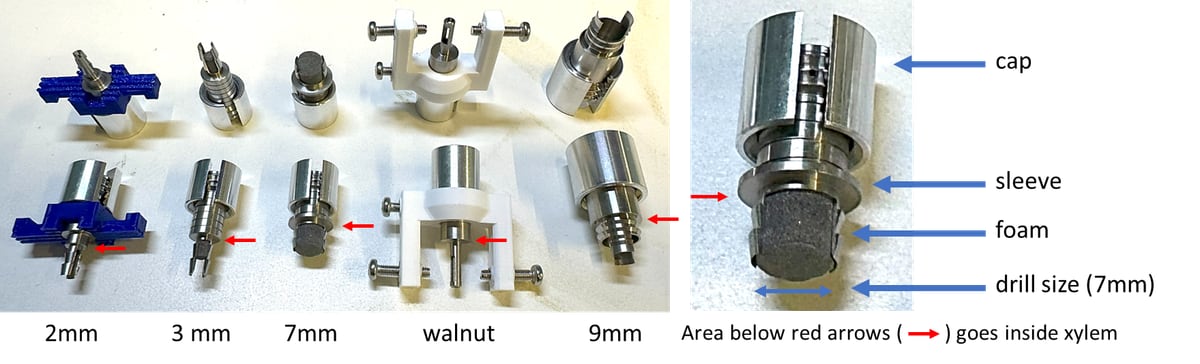
Small sensor installation hardware versions
- 7mm – We recommend this sensor for the vast majority of crops types and trunk sizes. This sleeve has a 7mm front opening for measuring water potential – this relatively large area allows faster transport of water between sensor and tree and thus has the quickest response and is less susceptible to clogging or temperature effects. It is the easiest to install and most robust of our versions.
- Use in: branches/trunks of 17+ mm in size, with bark thickness < 10 mm
- Installation video (with clamp), with hammer
- 3mm – We recommend this sensor for crops that are too small for the 7mm version. The 3mm version creates a smaller wound and allows installation into smaller crops, but it has a smaller water-exchange area and this makes it more susceptible to clogging and temperature effects. It is thus less reliable and accurate than the 7mm version, but can work well in smaller crops.
- Use in: branches/trunks of 11 to 16 mm in size.
- Installation video
- Thick bark – Generally sensors should be installed into branches, as branches have thinner bark and allow easier installation. But in many forest species, there is only access to the large trunk with very thick bark. This sensor version allows installation into tree trunks that have bark as thick as 2” or more.
- Use in: trunks with bark thicker than 10 mm.
- Installation video
- Walnut – FloraPulse sensors are generally installed on the side of a branch or the trunk, but there are ‘wet’ crops that create a strong wound response and prevent SWP measurement using our typical installation method. The walnut installation method places the sensor inside a branch pith, which in some species circumvents the wounding response and allows measurement.
- Use in: walnut (experimental), pecan (still testing) and avocado (still testing)
- Installation video
- 2mm – This sensor version is generally only recommended for very small stems, if you have no other choice, and without guarantees of accuracy. The 2mm version only has 8% of the surface exchange area compared to our standard 7mm version. This smaller area dramatically slows down the sensor response and creates more potential for issues with clogging and temperature effects. This smaller sensor also has weaker attachment to the trunk and should be reinforced with a 3d printed bracket.
- Use in: branches/trunks of 8 to 10 mm in size.
Big sensor installation hardware version (discontinued)
- 9mm – The original big sensor, sold from 2020 until it was discontinued. We no longer sell or recommend this version – the 7mm sensor above is recommended for the vast majority of crop types and trunk sizes.
- Discontinued – no longer sold. Existing 9mm systems remain usable on their current installs.
- Installation video