
uTensiometer Analog Probe Manual
720 Olive Dr Ste E
Davis CA, 95616
(530) 220-7668
About
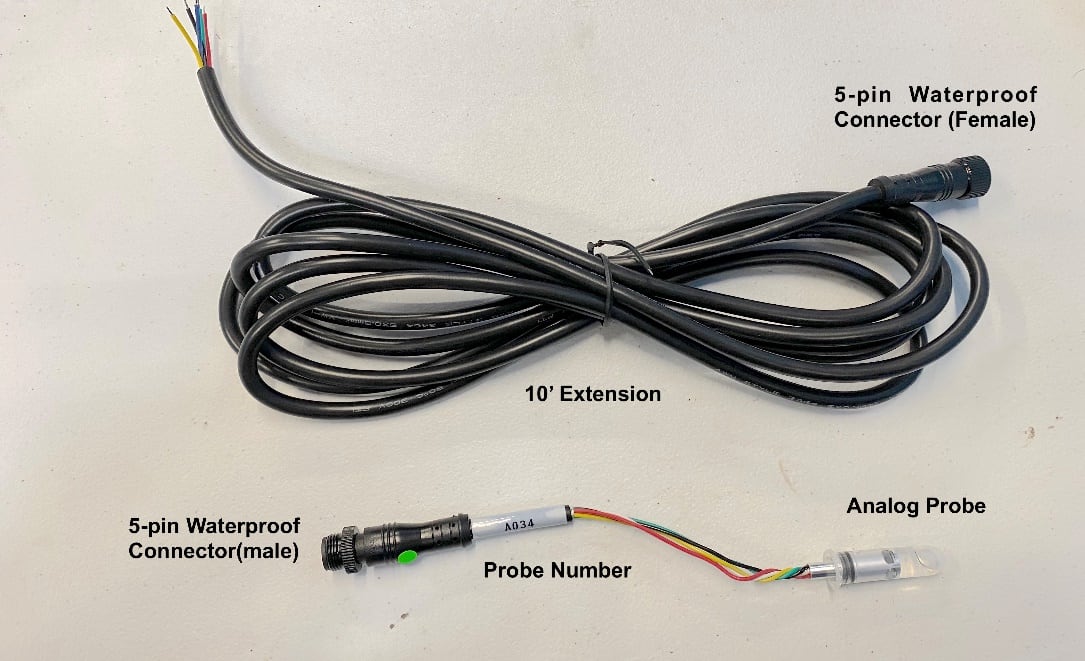
The uTensiometer analog probe directly measures the tree water potential. The probe itself is about 6” long and features a waterproof connector on one end. It comes with a detachable 10’ extension that has individual wires for excitation and readout. You may upgrade to a 49’ extension cord for a fee. The probe comes in a capsule of water and needs to be kept wet at all times.
Connecting to a logger
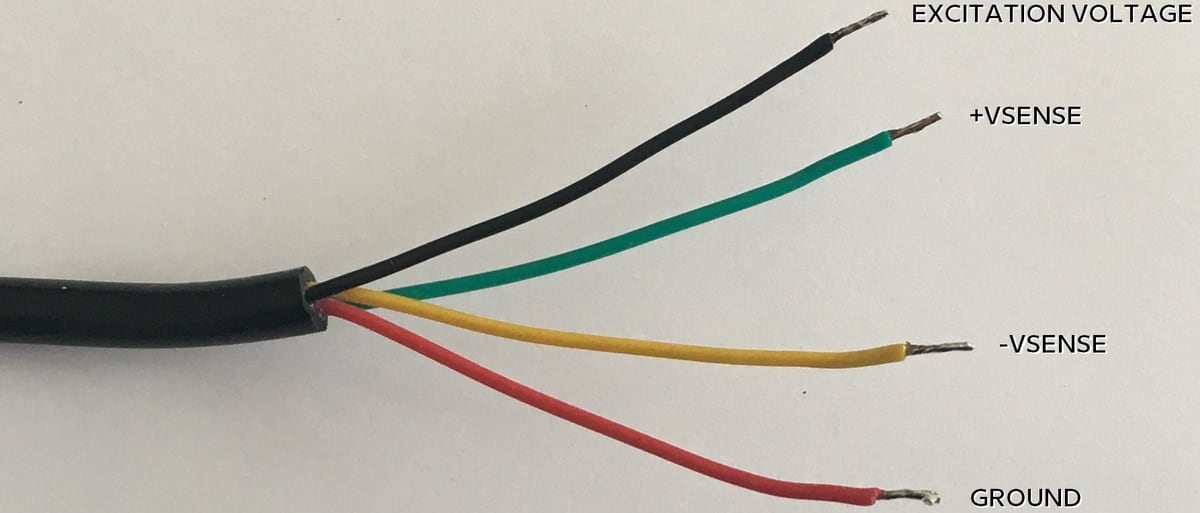
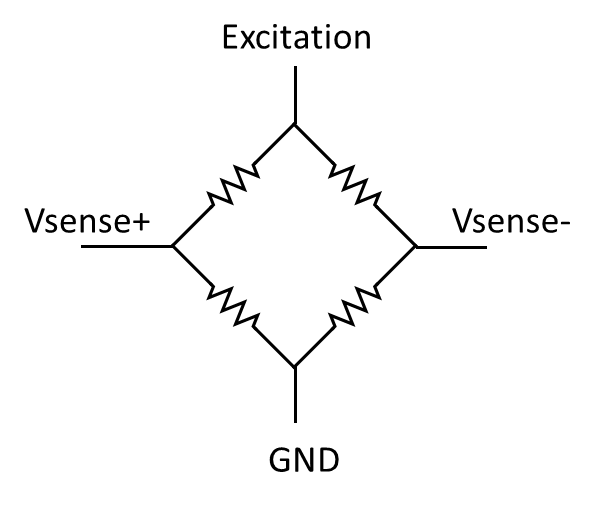
The analog probe has 4 leads: Excitation voltage (BLACK), Ground (RED), +Vsense (GREEN) and -Vsense (YELLOW). We recommend applying an excitation voltage of 1 V to 10 V (preferably 1 V), noting that the sensor should be excited in pulses of short duration (10 ms), particularly at higher excitations, to prevent resistive heating of the water reservoir. The sensor output is read between the Vsense leads. The BLUE wire connects to a temperature-calibration resistor used during manufacture and should be cut off if present.
The probe measurement circuit consists of a Wheatstone bridge with 4x resistances of ~2 kΩ each. Actual resistance values vary from device to device.
Measuring water pressure
Each sensor is individually calibrated at the factory and the calibrations are provided in the packing list with your shipment. Each sensor has a serial number and two calibration values: the offset (in bars) and the slope (bar/mV/V).
The calibration equation is:
| Variable | Units | Comments |
|---|---|---|
| Serial number | ‘Name’ for the sensor. Each sensor has individual calibration values | |
| Slope | bar/mV/V | Calibration coefficient. Given in the packing list with your sensor |
| Offset | bar | Calibration coefficient. Given in the packing list with your sensor. |
| bPT | mV/V | Not used. Gives the expected sensor output when the sensor is in water. |
| Voltage_input | V | Voltage used to excite the sensor. Should be 1 V to 5 V. |
| Voltage_output | mV | Measured voltage from the sensor. The value should be within -32 mV to +32 mV per V applied (example: -32 to 32 mV for 1 V Voltage_input, -64 to 64 mV for 2 V Voltage_input). |
| Pressure | bar | Measured pressure from the sensor. |
Extending the probe wiring
It is possible to extend the analog sensor wiring, but we recommend extreme care when splicing the wire. The analog signal is weak and easily disturbed by poor electrical connections.
Guidelines for splicing the wire
- Use large gauge wire for the extension, at least 22 AWG. Stranded wires are better.
- Solder and individually seal each individual wire. We recommend use of solder seal type splices, followed by heat-shrink over the bundle of wires.
- We have tested extensions of up to 50 ft. Longer extensions are possible, but should be tested.
- Always test measuring the sensor with and without the extension to ensure the extra wire isn’t introducing unwanted noise. The sensor voltage output should be unchanged before/after the extension.
Specifications
Measurement specifications
- Water potential range: 0 to -35 bar
- Sensor will cavitate and require refilling if exposed to water potentials below -35 bar, or ambient air.
- Temperature range: 5 °C to 50 °C
- Sensor will freeze below 0 °C, performance degrades above 50 °C
Electrical specifications
- Water potential sensor
- Required input: 1 V excitation (up to 10 V excitation if using 10 ms pulses)
- Pressure output: -32 mV/V to +32 mV/V
- Resolution: ~5 bar/mV, 0.1 bar
Physical specifications
- Probe length: 6”
- Pig-tail extension length: 10’
- Connector type: IP67 waterproof
Sample datalogger programs
You can download example programs to read FloraPulse analog and SDI-12 sensors with Campbell Scientific dataloggers at this link.