
Macadamia
ExperimentalThe sensor gives usable readings here, but the dataset is thin and there are no published thresholds. Sold for research and supervised field trials only — not for commercial irrigation scheduling. Growers: stick to the Validated list.
Performance
Recommended for experimental and initial grower use. First commercial field season (Queensland, Australia, from June 2026; 7 mm probes on cultivars 741 and A203): three of four probes were still cycling cleanly after 92 days, the daily swing grew from about 5 bar in mid-winter to 11-14 bar as evaporative demand rose, and stem water potential recovered within a day of irrigation. One probe lost hydraulic contact after a week and read wet, the same failure family seen in apple but at a lower rate. Field stem water potential swings far wider than the leaf-based literature suggests (midday to -19 bar at a -5 bar predawn in mid-winter), so the published thresholds are a guide only. No pressure-chamber comparison yet. The horticulturist at the orchard after the first two weeks: “This data that is coming in is awesome, very happy so far.” An independent agronomist, relaying the operators at the same orchard three months in: with macadamias “they have found them to be an invaluable irrigation scheduling tool.”
Installation Tips
- Macadamia is described in the literature as isohydric, but stem water potential in the field swings 10-15 bar a day once demand picks up. Irrigate on the multi-day trend and on the recovery after each irrigation rather than on a single absolute number.
- Use the literature bands (well-watered around -4 bar midday stem, stress onset around -9 bar) as guard-rails while you learn the orchard. In the first field season healthy trees reached -15 to -19 bar midday between irrigation sets, then recovered to a -2 bar predawn within a day of a set.
- Install two probes per tree. The one wet-reading probe in this trial was caught only because its neighbour kept swinging.
Known Issues
- One of four probes read wet from day 7 (daily swing 23-50% of its neighbour, midday near -1.5 bar): the wet-reading failure seen in apple, at a lower rate.
- No pressure-chamber comparison yet, and the install has not been through a wet season (December to March). Both are still needed, so the crop stays Experimental: sold for research and supervised trials, not for commercial irrigation scheduling.
Data & Validation
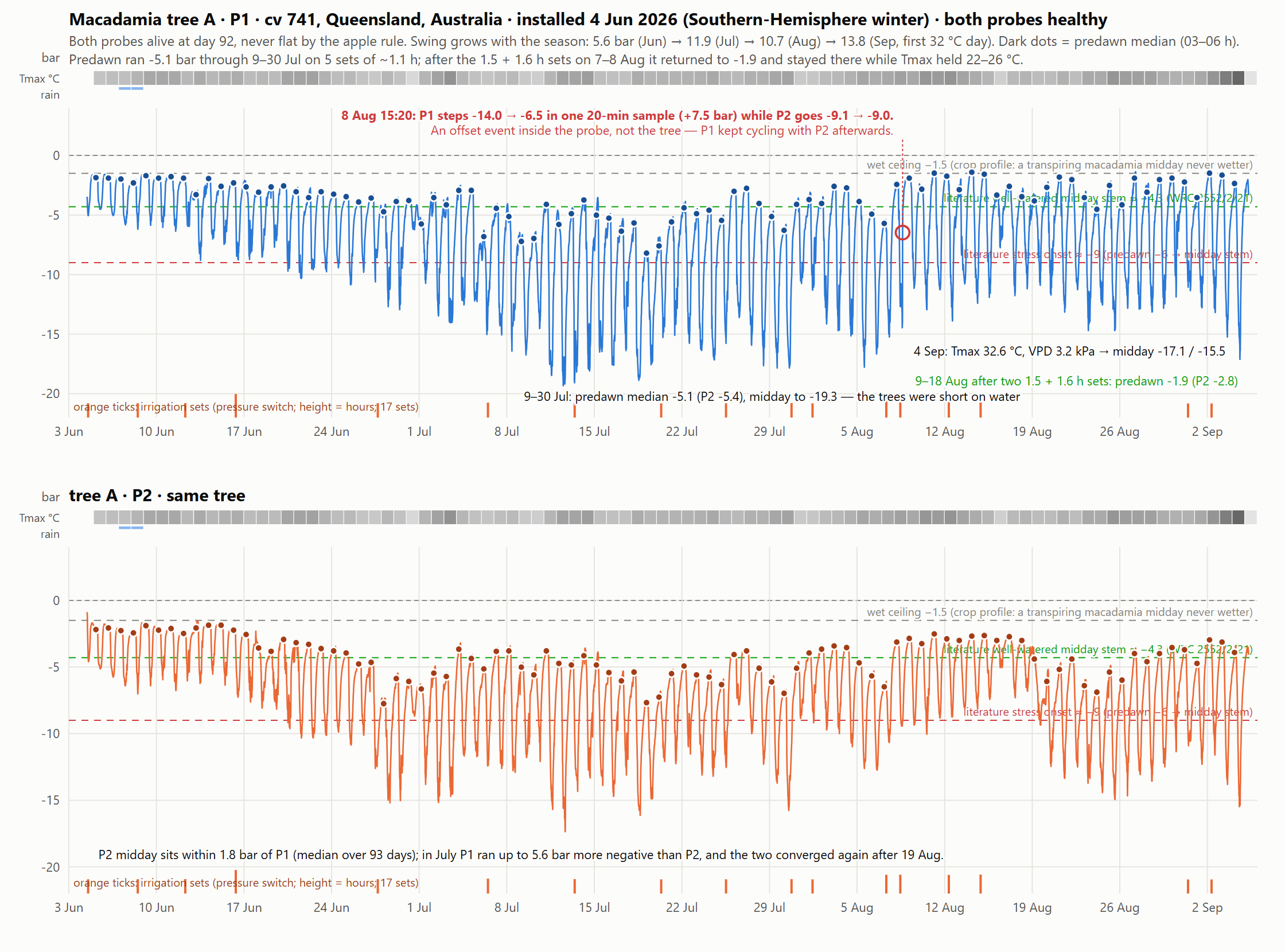
Tree A, cultivar 741, both probes, June to September 2026 (Southern-Hemisphere winter to spring). The daily swing grows with evaporative demand and the predawn (dark dots) recovers after the 7-8 August irrigation sets.
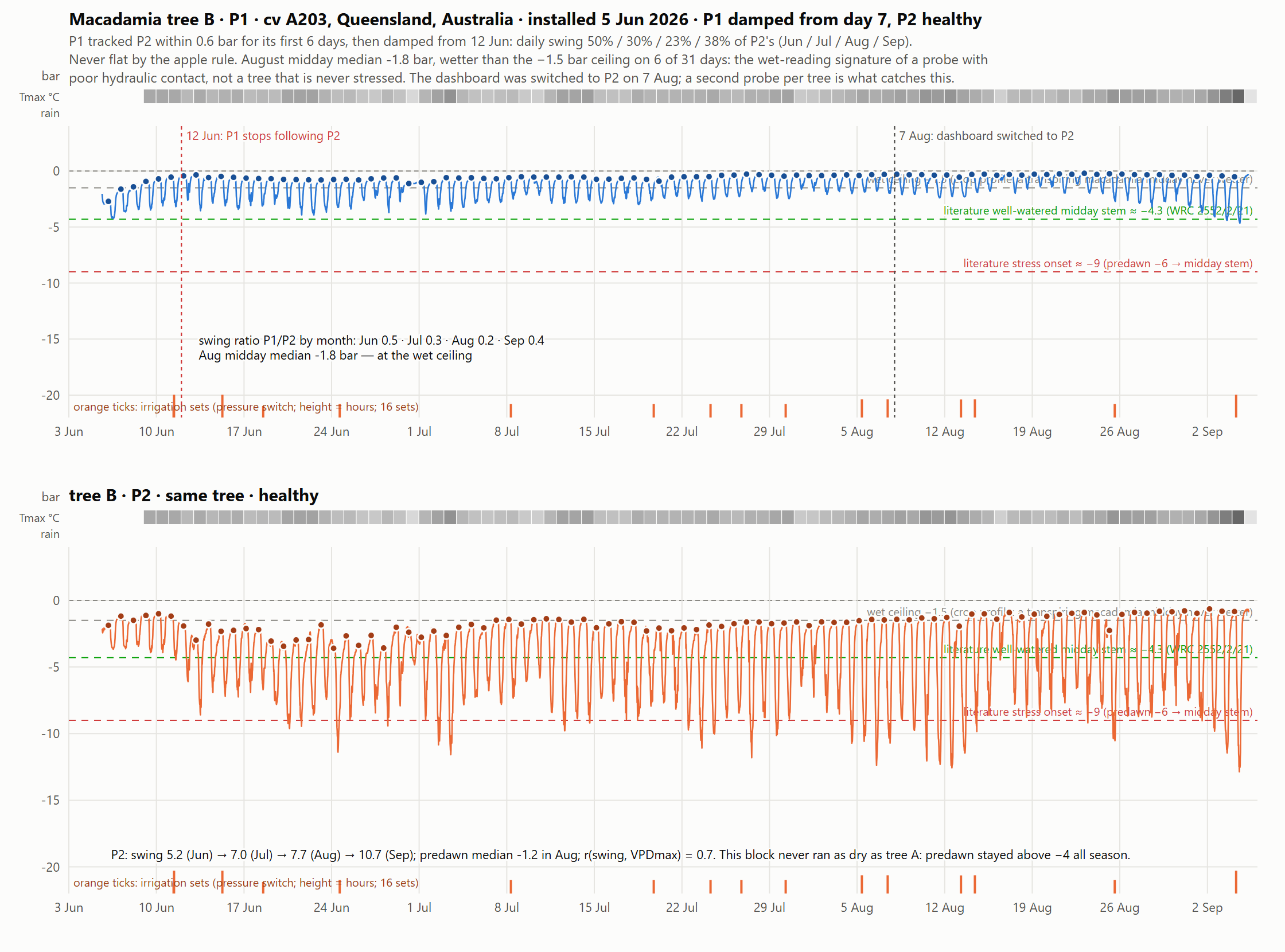
Tree B, cultivar A203. Probe 2 healthy all season; probe 1 damped from day 7 and read wet.
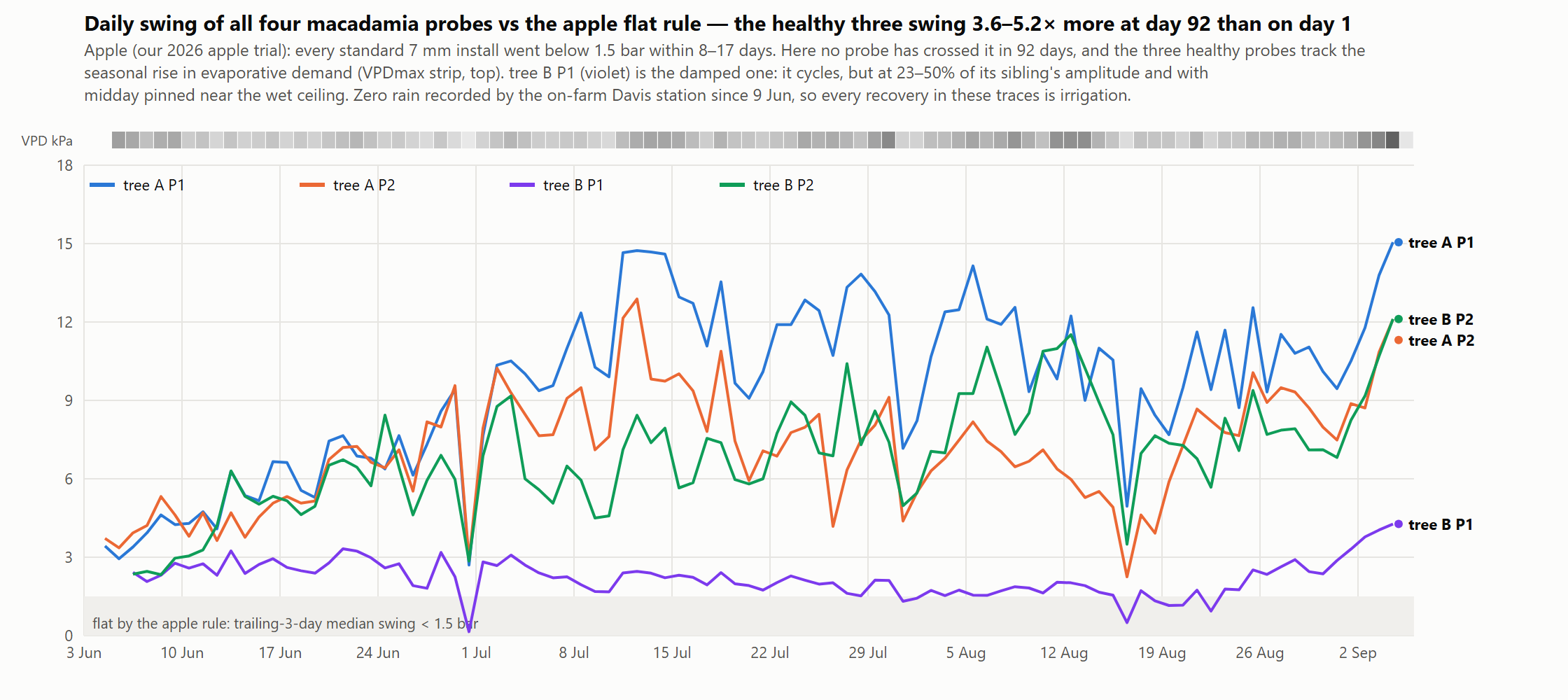
Daily swing of all four probes against the apple flat rule (trailing 3-day median swing below 1.5 bar). No probe crossed it in 92 days.
Research Library
The FloraPulse macadamia advisory engine draws on 10 sources — 4 peer-reviewed papers plus university extension, industry and vendor guidance. All 10 citations are verified — against the Crossref or DataCite registry, the live document, or by hand against the publisher's record — and marked ✓. Each entry notes the specific finding it contributes. See these sources in the research library, which spans every crop.
Questions this research answers
- What did Smit et al. 2020 find about macadamia irrigation?
- What did Carr 2013 find about macadamia irrigation?
- What did Stephenson et al. 2003 find about macadamia irrigation?
- What did Shane & Lambers 2005 find about macadamia irrigation?
Peer-reviewed research (4)
- Carr, M.K.V. (2013). The water relations and irrigation requirements of macadamia: a review. Experimental Agriculture 49(1):74-90. ✓
A review of macadamia water relations and irrigation. It describes shallow, spreading roots with a dense fibrous mat in the top 0.4 m, drought-tolerance traits including stomatal closure without a matching change in leaf water potential, and concludes that irrigation trials have been too poorly designed to say where and when irrigation pays.
- Shane, M.W. & Lambers, H. (2005). Cluster roots: a curiosity in context — Proteaceae phosphorus sensitivity / toxicity. Plant and Soil 274:101-125. ✓
A review of cluster (proteoid) roots, the nutrient-scavenging adaptation that Macadamia integrifolia shares with other Proteaceae. Cluster-root formation is enhanced at very low phosphate supply (about 1 uM P or less) and suppressed at higher P supply, and some Proteaceae develop phosphorus-toxicity symptoms at relatively low external P.
- Smit, T.G., Taylor, N.J. & Midgley, S.J.E. (2020). The seasonal regulation of gas exchange and water relations of field-grown macadamia. Scientia Horticulturae 267. ✓
Eighteen months of gas-exchange work on irrigated mature 'Beaumont' macadamia in South Africa: light-saturated assimilation was low (about 8.3 umol CO2 m-2 s-1), stomatal conductance declined once leaf-to-air VPD passed roughly 2 kPa, and midday leaf water potential stayed nearly constant near -1.16 MPa, confirming isohydric behaviour.
- Stephenson, R.A., Gallagher, E.C. & Doogan, V.J. (2003). Macadamia responses to mild water stress at different phenological stages. Aust. J. Agric. Res. 54(1):67-75. ✓
Bearing macadamia trees in through-draining lysimeters were dried to a xylem water potential of -1.5 to -2.0 MPa at different phenological stages. Stress during nut maturation hurt both yield and quality most; stress during floral development and premature nut drop also hurt, while stress at floral initiation was generally not detrimental.
University & extension guidance (3)
- Queensland Department of Primary Industries. Macadamia pest fact sheets (macadamia nutborer, fruit-spotting bug). ✓
The Queensland government's agriculture pages carry per-pest fact sheets relevant to macadamia orchards, for example macadamia nutborer (Cryptophlebia ombrodelta) and fruit-spotting bug, each giving distribution, host range, damage description, monitoring method and control options, including the parasitoids that supply useful biological control.
- Stephenson, R.A. & Gallagher, E.C. (1986). Effects of temperature on premature nut drop in macadamia. Qld J. Agric. Anim. Sci. 43(2):97-100. ✓
Potted five-year-old macadamia trees were held in controlled-environment glasshouse bays for 10 weeks after nut set. Day temperatures of 30 and 35 C caused more early nut drop than 20 and 25 C, and the authors suggest 30 C may be the point at which premature nut drop becomes unacceptable.
- Taylor, N.J. et al. (2021). Water Use of Macadamia Orchards Vol 2. WRC Report 2552/2/21, Water Research Commission & SAMAC (South Africa). ✓
South African sap-flow study of 'Beaumont' macadamia: annual transpiration averaged 328 mm in a mature orchard and 181 mm in an intermediate one. Trees were predominantly isohydric, with stomatal conductance declining once leaf-to-air VPD passed 2.5 kPa, and the report proposes predawn leaf water potential below -0.6 MPa as the onset of stress.
Industry & agency resources (3)
- Hort Innovation. Macadamia industry benchmarking and industry sustainability insights 2022-2027 (project MC22000). ✓
Hort Innovation's levy-funded project MC22000, Macadamia industry benchmarking and industry sustainability insights 2022-2027, sources, analyses and publishes productivity, quality and sustainability metrics from individual farm up to industry level so Australian growers can benchmark their own performance against comparable farms.
- SAMAC (Macadamias South Africa) Phenology Calendar (2024). ✓
SAMAC's one-page Southern Hemisphere macadamia calendar. It maps the season from flowering and nut set in August to October, through October and November premature nut drop, shell hardening and oil accumulation, to harvest, and lines up root and leaf growth, expected nut diameter by month, and the matching orchard tasks.
- SAMAC Information Hub - South African macadamia cultivation guidance (water needs, flowering-window irrigation demand, heat thresholds). ✓
SAMAC's grower Information Hub carries South African macadamia cultivation guidance: a mature tree is currently reckoned to need roughly 500 to 600 mm of water a year, August and September carry the highest irrigation demand because that is when most cultivars flower and set nuts, and temperatures above 35 C reduce photosynthesis.